Home Blog Page 3

Best Screen Recorder for Roblox in 2026: Free and Paid Options Compared

0
roblox redeem toy and virtual item codes new

The best free screen recorder for Roblox in 2026 is OBS Studio โ€” zero cost, no watermark, no FPS cap, and works for both recording and live streaming. For players who want automatic clip detection, Medal.tv (free, local) and Eklipse (free, cloud-based for streamers) add AI that identifies your best moments without reviewing hours of footage.

This guide covers every option โ€” from the simplest one-click recorders to full streaming + auto-clip setups โ€” so you can pick the right tool for how you actually play.


TL;DR

  • Best free recorder (no restrictions): OBS Studio โ€” no watermark, any resolution, no clip length limit
  • Best for simplicity: Medal.tv โ€” install, play, it clips automatically
  • Best for streamers wanting auto-clips: Eklipse โ€” processes your Twitch/Kick Roblox VOD into 9:16 clips post-stream
  • Built-in option (Windows): Xbox Game Bar (Win+G) โ€” instant replay, no install, lower quality
  • Avoid: Free screen recorders with 10-minute limits or mandatory watermarks

1. OBS Studio โ€” best overall free recorder

Free. No watermark. No time limit. No catch.

OBS Studio is the most capable free screen recorder available. It captures Roblox at any resolution and frame rate with zero mandatory watermark, supports both local recording and live streaming, and runs on Windows, macOS, and Linux.

Setup for Roblox recording:

  1. Download from obsproject.com
  2. Add a Game Capture source, select Roblox
  3. Set output: 1920ร—1080, 60fps, NVENC H.264 (NVIDIA) or AMF (AMD)
  4. Press Start Recording

Why Game Capture over Display Capture: Game Capture hooks directly into the Roblox process โ€” lower CPU overhead, no lag from capturing a secondary monitor, and Roblox renders in full quality.

Recommended recording settings:

SettingValue
EncoderNVENC H.264 (NVIDIA) or x264 (CPU)
Rate controlCRF (recording) โ€” use CRF 18โ€“23
Resolution1920ร—1080
FPS60
FormatMP4 (easier to edit) or MKV (safer if OBS crashes)

Trade-off: OBS has no automatic clip detection. You record everything and manually find the good moments afterward โ€” or you use the replay buffer (records the last N seconds on hotkey) to save specific moments as you play.

Best for: Roblox players who want full control, no restrictions, and plan to edit clips manually or use a separate tool for highlight detection.


2. Medal.tv โ€” best for automatic clip detection (offline players)

Free tier available. Runs locally. AI detects highlights automatically.

Medal.tv runs as a background process during your Roblox session. It captures everything and uses AI detection to identify notable moments โ€” kills, deaths, certain score events โ€” and saves short clips automatically.

How it works:

  1. Install Medal from medal.tv
  2. Launch Roblox โ€” Medal starts capturing automatically
  3. After your session, open Medal and review detected clips
  4. Download and share from the Medal interface

For Roblox specifically:

  • Works well for PvP games (Arsenal, Combat Warriors, Da Hood) โ€” kill events are detected reliably
  • Limited for progression games (Blox Fruits, Pet Simulator) โ€” “fruit awakening” isn’t a standard kill event
  • Captures funny moments only if they trigger an audio spike โ€” not as sophisticated as chat-based detection

Performance impact: 8โ€“12% CPU during recording. On a modern Ryzen 5 or Core i5 PC, this is barely noticeable. On older or lower-spec machines, you may see frame drops in busy Roblox maps.

Free plan limitations: 720p capture, Medal watermark on exports. Medal Pro removes the watermark and unlocks higher resolutions.

Best for: Roblox players who don’t stream live and want automated clip detection without any streaming setup.


3. Eklipse โ€” best for Roblox streamers

Free tier available. Cloud-based. Zero FPS impact. Processes Twitch/Kick VODs automatically.

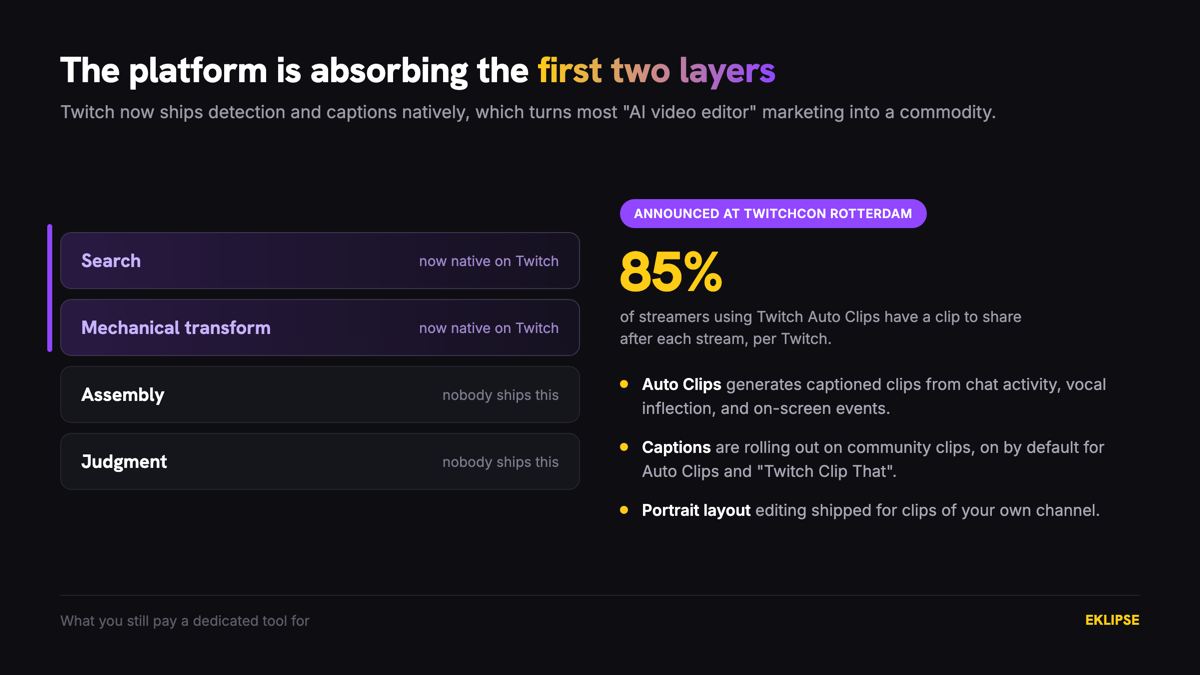
Eklipse is not a traditional screen recorder โ€” it processes your Twitch or Kick VOD after your stream ends. Connect your Twitch account, stream Roblox as normal, and Eklipse finds your best moments and exports them in 9:16 vertical format for TikTok and YouTube Shorts.

How it works:

  1. Create an account at app.eklipse.gg
  2. Connect Twitch or Kick via OAuth
  3. Stream Roblox โ€” no changes to your setup
  4. After the stream, Eklipse processes the VOD automatically
  5. In 20โ€“60 minutes, detected clips appear in your dashboard ready to download

What makes it different for Roblox:

  • Chat spike detection: When 300+ chat messages appear in 5 seconds, something notable happened. Eklipse catches this โ€” a funny moment, an unexpected clutch, a dramatic event โ€” even if it didn’t generate a kill-feed event
  • Zero performance overhead: Runs entirely in the cloud after your stream ends. Your Roblox session is unaffected
  • 9:16 output by default: No reformatting for TikTok or Shorts โ€” clips are already the right aspect ratio

Best for: Roblox streamers on Twitch or Kick who want automatic highlights from their VODs without reviewing footage manually.

Requires: Active Twitch or Kick account with VOD storage enabled.


4. Xbox Game Bar โ€” built-in Windows option

Free. Built into Windows 10/11. Zero install required.

Press Win+G while Roblox is running to access Xbox Game Bar. It includes:

  • Screen recording (record your session)
  • Instant replay (saves last 30โ€“120 seconds via Win+Alt+G hotkey)
  • Screenshot (Win+Alt+PrtScn)

Pros: Already on your PC, zero setup, hotkey accessible during gameplay.
Cons: Lower quality than OBS, no AI detection, 16:9 only, limited bitrate control, doesn’t work in all Roblox modes.

Best for: Casual Roblox players who need to clip something once and don’t want to install software.


5. NVIDIA ShadowPlay / GeForce Experience

Free with NVIDIA GPU. Hardware-accelerated. Minimal performance impact.

If you have an NVIDIA GPU (GTX 1060 or newer), ShadowPlay is worth using:

  • NVENC hardware encoding โ€” CPU overhead is near-zero (2โ€“4%)
  • Instant Replay: saves the last 5โ€“30 minutes on hotkey (Alt+F10)
  • Auto-saves highlights for some games (not Roblox-specific)
  • No time limit, no watermark

Setup: Install GeForce Experience, enable In-Game Overlay, configure Instant Replay duration.

For Roblox: Manual trigger โ€” you press the hotkey when you want to save a clip. No automatic detection.

Best for: NVIDIA GPU owners who want high-quality, zero-overhead instant replay without any subscription or AI detection.


6. AMD ReLive / Radeon Software

Free with AMD GPU. Similar to ShadowPlay for AMD hardware.

AMD ReLive captures via hardware encoding on AMD GPUs with minimal overhead. Instant replay, manual trigger, no watermark, no time limit.

Best for: AMD GPU owners who want the ShadowPlay equivalent for free.


Comparison table

ToolCostFPS ImpactAI DetectionOutput FormatBest For
OBS StudioFreeLow (GPU encode)โŒ Manual only16:9Full control, streaming
Medal.tvFree / Pro8โ€“12% CPUโœ… Kill events16:9Offline players, simple setup
EklipseFree / PaidZeroโœ… Full VOD (chat + kills)9:16 โœ…Twitch/Kick streamers
Xbox Game BarFree (built-in)LowโŒ16:9Casual, no install
ShadowPlayFree (NVIDIA GPU)Near-zeroโŒ Manual trigger16:9NVIDIA users, instant replay
AMD ReLiveFree (AMD GPU)Near-zeroโŒ Manual trigger16:9AMD users, instant replay

What to consider when choosing

Do you stream Roblox on Twitch or Kick? โ†’ Eklipse. Zero overhead, post-stream automation, 9:16 output. Add OBS for the actual streaming.

Do you play Roblox without streaming? โ†’ Medal.tv if you want AI detection, OBS or ShadowPlay if you prefer manual clipping with higher quality.

Do you have an NVIDIA GPU? โ†’ ShadowPlay for instant replay hotkey recordings, OBS for full sessions.

Do you just need to clip something occasionally? โ†’ Xbox Game Bar. Already installed, no setup.

Do you want to post Roblox clips to TikTok and YouTube Shorts? โ†’ Either Eklipse (if you stream) or record with OBS then reformat in CapCut.


Frequently asked questions

Does recording Roblox use more CPU?

Yes, but hardware-accelerated recording (NVENC, AMF, ShadowPlay) has very low overhead โ€” 2โ€“5% CPU. Software encoding (x264 in OBS) uses more CPU โ€” 20โ€“40% depending on quality settings. Use hardware encoding for Roblox to minimize FPS impact.

Can I record Roblox gameplay on a laptop?

Yes. OBS runs on laptops. Use hardware encoding (NVENC if NVIDIA, AMF if AMD Radeon, QuickSync if Intel) to keep CPU overhead low on laptop thermals. Lower the bitrate (4,500 kbps instead of 6,000) to reduce heat buildup.

Will screen recording cause Roblox to ban me?

No. Recording your own gameplay is permitted. Roblox doesn’t ban players for using screen recorders.

How do I record Roblox clips on a school or work PC?

If you can’t install software, use Xbox Game Bar (Win+G) โ€” it’s already on Windows 10/11 and doesn’t require admin permissions in most configurations.


The right recorder for your Roblox setup

  • Streamers: OBS for streaming + Eklipse for auto-clips from your VOD
  • Offline players with NVIDIA GPU: ShadowPlay for instant replay + Medal for AI detection
  • Offline players without dedicated GPU: OBS recording + Medal for AI clip detection
  • Casual one-off clips: Xbox Game Bar

Clip your Roblox streams automatically with Eklipse โ€” free โ†’

Best Posting Times for Gaming Content on TikTok 2026

0

Posting time matters less than consistency, but it matters more than most streamers think. A clip posted at 2 AM might get 200 views. The same clip posted at 7 PM might get 2,000. The content didn’t change โ€” the audience availability did.

Here’s what the data says about optimal posting times for gaming content on TikTok in 2026.


The General Rules

Before getting platform-specific, these patterns hold across all short-form platforms:

Peak engagement hours: 7-10 PM local time (viewers are home, scrolling after work/school)
Secondary peak: 12-3 PM local time (lunch break scrolling)
Lowest engagement: 12-6 AM local time (audience is asleep)
Weekend vs weekday: Weekends have a broader peak (11 AM – 10 PM). Weekdays are tighter (12-2 PM and 7-10 PM).

The caveat: These are averages across all content types. Gaming audiences have slightly different patterns because the audience skews younger and stays up later.


Gaming Audience-Specific Patterns

Gaming streams typically run 6-11 PM local time. That means:

  • Pre-stream (5-7 PM): Viewers are killing time before their own streams or favorite streamers go live. Good for hype clips that preview what’s coming.
  • Post-stream (10 PM – 12 AM): Viewers are decompressing, scrolling after watching streams. This is the highest-engagement window for gaming clips.
  • Morning after (8-11 AM): Viewers checking their feeds from yesterday. Good for clips from last night’s stream.

The best general window for gaming clips: 7-11 PM local time, with a strong preference for 9-11 PM.


Platform-Specific Data

TikTok

DayBest TimeRunner UpNotes
Monday7-10 PM12-2 PMPost-stream scrolling audience
Tuesday8-11 PM1-3 PMSecond highest engagement day
Wednesday8-11 PM12-2 PMHump day โ€” evening scrolling is high
Thursday7-10 PM12-2 PMPre-weekend anticipation
Friday6-9 PM11 AM-1 PMEarlier peak โ€” people make weekend plans
Saturday10 AM-12 PM, 7-10 PMโ€”Bimodal: morning + evening
Sunday10 AM-1 PM, 6-9 PMโ€”Casual scrolling day

TikTok gaming sweet spot: Tuesday-Thursday, 8-10 PM in the viewer’s timezone.

YouTube Shorts

DayBest TimeNotes
Mon-Fri2-5 PMAfternoon slump browsing
Sat-Sun10 AM-2 PMWeekend morning browsing

Shorts has a different audience behavior โ€” more search-driven, less feed-driven. Posting time matters less for Shorts than TikTok because clips can rank in search for weeks.

Shorts gaming sweet spot: Weekdays 2-4 PM.

Instagram Reels

DayBest TimeNotes
Mon-Fri11 AM-2 PMLunch break scrolling
Sat9 AM-12 PMWeekend morning

Reels has the least time sensitivity of the three platforms. Posting time matters about 30% less than TikTok according to multi-platform tests.

Reels gaming sweet spot: Weekdays 11 AM-1 PM.


Timezone Strategy

If your audience is concentrated in one region, post in their peak time. If it’s global, you have a choice:

Option 1: Target your primary timezone
Post during peak hours in your home region. Accept that viewers in other timezones may see it during lower-engagement windows.

Option 2: Target a global sweet spot
Post at 7-9 PM UTC. This hits:

  • Late evening in Europe (8-10 PM CET / 7-9 PM GMT)
  • Afternoon in US East (2-4 PM EST)
  • Morning in US West (11 AM-1 PM PST)
  • Late night in Asia (2-4 AM JST โ€” suboptimal)

Best for most streamers: Option 1. Your live audience is likely concentrated in your timezone. Posting when they’re active maximizes initial engagement, which signals the algorithm to push the clip further.


When Posting Time Doesn’t Matter

Posting time matters less in these scenarios:

  • You have 10K+ followers: The algorithm pushes your content to your existing audience regardless of time. They’ll see it when they open the app.
  • Your clip goes viral through shares: A share-driven viral loop bypasses time-of-day patterns entirely.
  • You post to YouTube Shorts from search keywords: A clip ranking for “valorant clutch” gets views at 3 AM because people search at 3 AM.
  • You’re posting consistently daily: Daily posters build a pattern โ€” the algorithm learns to expect and push their content. Posting time flexes within the expected window.

Practical Posting Routine

Rather than obsessing over exact minutes, use a simple rule:

Post in the evening, 7-10 PM your local time.

Consistency across that window matters more than precision within it. A clip posted at 8:15 PM every day will outperform a clip posted at varying times that sometimes hit the peak.


How to Find Your Actual Best Time

Generic data is a starting point. Your audience may differ. To find your actual best time:

  1. Post at the same time for 2 weeks
  2. Switch to a different time slot for 2 weeks
  3. Compare average views in the first 24 hours

Do this across 3 time slots (evening, afternoon, morning) and you’ll have a clear picture of your audience’s behavior. Re-test every 3-6 months as your audience grows and changes.


Tools That Help With Timing

ToolWhat It Does
TikTok AnalyticsShows when your followers are active (Pro account required)
Native schedulerTikTok and Instagram let you schedule posts in advance
Buffer/HootsuiteCross-platform scheduling (paid)
Phone alarmSimplest: daily alarm at your posting time

The simplest effective system: set a daily alarm at your chosen posting time. Open the app. Post. Done. No data analysis needed.


Bottom Line

While TikTok’s 2026 algorithm is smarter than ever, human availability hasnโ€™t changed. Tuesday through Thursday, 8โ€“10 PM remains the ultimate sweet spot for gaming discovery. For YouTube Shorts, focus on the 2โ€“4 PM afternoon slump, and for Reels, aim for the 11 AMโ€“1 PM lunch break.

Set your window, stick to it, and let the algorithm do the heavy lifting. Consistency in timing signals to both your followers and the platform that your content is a reliable part of their daily feed.

Ready to hit those peak times without the stress?

Don’t let manual editing keep you from hitting your optimal posting window. Let AI generate your clips so you always have a library of content ready to go the moment the clock strikes 8 PM.

Start auto-clipping your streams with Eklipse โ†’ time for gaming clips on TikTok: Tuesday-Thursday, 8-10 PM local time. For Shorts: 2-4 PM weekdays. For Reels: 11 AM-1 PM weekdays.

But consistency across those windows beats precision within them. A daily post at 8 PM that’s sometimes 7:45 and sometimes 8:15 will outperform a post that randomly hits 7 PM one day and 11 PM the next.

Set your window. Post within it. Move on.

Stream Hook Strategy: First 2 Seconds of a Gaming Clip

0

The swipe happens in under a second.

A viewer scrolls their TikTok feed. Your clip appears. They have about 800 milliseconds to decide whether to watch or scroll past. If the first 2 seconds don’t signal “something is about to happen,” you’ve lost them.

This isn’t about clickbait. It’s about signaling โ€” giving the viewer enough information in the first moments to justify their attention. Gaming content has a specific advantage here (action is inherently visual) and a specific disadvantage (setup is boring without context).

Here’s how to nail the first 2 seconds of every clip.


The 3 Types of Hooks for Gaming Clips

Hook 1: The Action Hook

Start the clip at the moment immediately before the peak. No setup. No slow pan. Just the crosshair on an enemy and a gun firing.

Example structure:

  • Second 0-1: Crosshair + enemy visible
  • Second 1-3: Action starts (kill, clutch, outplay)
  • Rest of clip: The full moment

Works for: Gameplay highlights, multi-kills, clutch rounds
Doesn’t work for: Reaction clips, comedy, tutorials

Best games: COD, Valorant, Fortnite, Apex, any FPS/Battle Royale

Rule: If the clip starts with your crosshair on nothing and you walking forward, cut the first 3 seconds. The action starts later than you think.

Hook 2: The Reaction Hook

Start with your face (webcam) mid-reaction. The viewer sees you laughing, screaming, or in shock before they see why.

Example structure:

  • Second 0-1: Your face reacting (mouth open, laughing)
  • Second 1-2: Cut to what caused the reaction
  • Rest of clip: Full moment + aftermath

Works for: Funny moments, chat reactions, fails
Doesn’t work for: Gameplay-intensive clips where the action is the star

Rule: If your reaction clip starts with 3 seconds of silent gameplay before you react, cut the gameplay. Start on the reaction, then show context.

Hook 3: The Text Hook

Start with text on screen that tells the viewer what they’re about to see. Used when the clip needs context to be understood.

Example structure:

  • Second 0-1: Text overlay โ€” “POV: You let chat choose your loadout”
  • Second 1+: The moment

Works for: Tutorials, challenges, contextual moments
Doesn’t work for: Pure gameplay clips (text distracts from action)

Rule: Text hooks should be 3-5 words max. If you need a sentence, the clip isn’t self-explanatory enough.


The Anti-Hook: What Kills the First 2 Seconds

These are patterns that guarantee a swipe:

The Slow Fade-In

A clip that starts black, fades into a landscape shot, then slowly zooms toward the action. On TikTok, this is a death sentence. The viewer has already swiped before the fade completes.

Fix: Start at the action. A hard cut into a clip is better than any transition.

The “Let Me Set This Up”

Voiceover that says “OK so what happened wasโ€ฆ” before the clip plays. Viewers don’t want setup. They want the moment.

Fix: Drop the setup. Show the moment. If context is essential, use a 1-second text overlay.

The Menu/Loading Screen

Clip starts with the game menu, inventory screen, or spawn area. Zero visual interest. Nothing signals “something is about to happen.”

Fix: Trim the first 5-7 seconds of every clip by default. You’ll be surprised how many clips start too early.

The Dead Air

Clip starts with 2 seconds of silence before anyone speaks or shoots. Silence signals “nothing is happening” even if the visual is interesting.

Fix: If there’s no audio hook in the first 2 seconds, start the clip later.


How to Find the Right Start Point

Most streamers start clips too early. Here’s a heuristic:

  1. Find the peak of the clip (the kill, the reaction, the punchline)
  2. Go back 2-3 seconds from that peak
  3. That’s your start point

For most clips, the natural start is 3-5 seconds of buffer before the peak, and you should cut that to 1-2 seconds.

If there’s nothing interesting in the first 2 seconds, the clip doesn’t get watched.


Platform-Specific Hook Differences

TikTok

  • Fastest swipe behavior. Action hook works best.
  • Text overlays in hooks perform well if the font is large and the text is short.
  • If you’re not using a gameplay hook, use a face hook (webcam reaction in first frame).

YouTube Shorts

  • Slightly longer attention span than TikTok.
  • Search-driven content (tutorials, tips) can use text hooks effectively.
  • First 2 seconds still matter, but Shorts viewers give slightly more context time (3-4 seconds).

Instagram Reels

  • Most forgiving of the three platforms for slower hooks.
  • Reaction hooks and text hooks perform better here than TikTok.
  • Reels viewers expect slightly more production polish in the hook (good lighting, clean audio, readable captions).

Hook Test: Before and After

Before (bad hook):
Clip starts with a Valorant player buying weapons at round start. 4 seconds of shopping. Then they walk toward site. 3 seconds of running. Then the engagement starts.

Result: 7 seconds of dead time before anything interesting happens. Most viewers swipe in the first 2 seconds.

After (good hook):
Clip starts with the crosshair at a corner. Enemy peeks at second 1. Shot fires at second 1.5.

Result: Hook at second 0 (crosshair + corner = imminent action). Engagement at second 1. Viewer is locked in.


Tools That Auto-Handle Hooks

Some tools trim clips to start closer to the action. This is a feature worth checking.

Eklipse: AI detection trims each clip to start at the high-signal moment, not before it. The first frame of a detected clip is already closer to the peak than manual clipping typically produces.

If you’re manually trimming clips, budget 30 seconds per clip to optimize the first 2 seconds. Look for the earliest point where:

  1. There’s motion on screen
  2. There’s audio happening
  3. Something is visually interesting (crosshair, enemy, explosion, reaction face)

If none of these exist at the start, trim earlier.


The 2-Second Rule

Before you post any clip, watch only the first two seconds. If you wouldn’t stop scrolling to watch that specific moment, your viewers won’t either.

This is the only editing rule that consistently predicts clip performance. A great hook doesn’t guarantee a viral hit, but a bad hook guarantees that nobody will stay long enough to see your best plays. In the fast-paced feed of 2026, you aren’t just competing with other streamers; you’re competing with a viewer’s thumb. Make it impossible for them to swipe.


Bottom Line

The “Action starts later than you think” mantra is your best friend. Trim the fluff, lead with the heat, and use text or reaction hooks only when they add immediate value. By mastering the first two seconds, you give your content the chance it deserves to be seen by the right audience.

Want clips that are already hook-optimized?

Don’t waste time hunting for the perfect start point. Let AI identify the peak action and trim the boring setup for you, so your clips are ready to stop the scroll the moment they’re generated.

Start auto-clipping your streams with Eklipse โ†’

How to Post Consistently on TikTok as a Streamer

0

Consistency is the single biggest predictor of short-form growth. Not production quality. Not follower count. Not even content quality, past a minimum threshold.

The streamer who posts 1 clip every day for 90 days will almost always outperform the streamer who posts 10 clips in one day then disappears for 3 weeks.

But consistency is hard when your primary job is streaming. You’re already spending 3-4 hours on camera. Adding “content creator” as a second job isn’t sustainable long-term.

Here’s how to make consistency automatic.


Why Streamers Struggle With Consistency

The barrier isn’t laziness. It’s workflow.

BarrierWhat It Actually IsSolution
“I don’t have time to edit”Manual editing takes 2 hours per streamAuto-clipping reduces this to 15 min
“I forget to post”No system, no routineSchedule a weekly post session
“My clips didn’t perform well”Posting 3 clips and judging resultsPost for 30 days before evaluating
“I don’t know what to post”Scrolling through raw VODs is overwhelmingLet AI find clips for you
“I’m tired after streaming”Editing is mentally draining after 4 hours on cameraSeparate creation from posting

Every consistency problem is actually a workflow problem. Fix the workflow and consistency follows.


The Minimum Viable Posting Schedule

If you’re starting from zero posting consistency, don’t aim for daily. Aim for:

Week 1-2: 3 posts per week

  • Tuesday: Post your best clip from the weekend stream
  • Thursday: Post a clip from mid-week stream
  • Saturday: Post a wildcard clip (different game or format)

Week 3-4: 5 posts per week

  • Add Wednesday and Sunday
  • You now have clips stockpiled from the previous weeks

Month 2+: Daily posting

  • 1 clip per day, every day
  • Use your buffer (clips from previous streams) so you never need to edit on the day of posting

This ramp lets you build the habit before scaling the volume. Most streamers fail by trying to post daily from day one โ€” they burn out in 2 weeks.


The One-Day Buffer System

Here’s a system that removes all daily friction:

Step 1: Auto-detect after every stream
Eklipse scans each VOD and produces clips automatically. You don’t need to be at your computer. Clips are ready by morning.

Step 2: The 10-minute Sunday session
Every Sunday, spend 10 minutes:

  • Open your clip dashboard
  • Select 7 clips for the week (skim, reject duds, pick the best)
  • Batch download all 7
  • Drag them into folders named MON through SUN

Step 3: Post daily (2 minutes each)
Monday morning: Open MON folder. Post to TikTok. Close.
Tuesday morning: Open TUE folder. Post to Shorts. Close.
โ€ฆRepeat.

Total weekly time investment: ~24 minutes (10 min Sunday + 2 min/day ร— 7 days).

No daily decisions. No “what should I post?” No opening an editor at 11 PM after a 4-hour stream.


What to Do When You Miss a Day

You will miss a day. Every streamer does. The difference is how you respond.

Don’t do this: Post 2 clips the next day to “catch up.” Algorithms don’t track rolling averages โ€” they track cadence. Double-posting doesn’t repair the cadence gap.

Do this: Post normally the next day. One clip. The same cadence as if you never missed. The algorithm resets after 2-3 consistent days.

The only danger is a missed day turning into a missed week. That’s a cadence reset. To avoid it:

  • If you miss 1 day: Post normally the next day. No penalty.
  • If you miss 3 days: Post normally for 3 days to re-establish cadence. Don’t panic-post.
  • If you miss 7 days: Your algorithm slot may have cooled. Accept it and restart. Account growth doesn’t regress permanently โ€” just pick up where you left off.

The 3 Metrics That Matter for Consistency

Instead of tracking vanity metrics, track the input metrics you control:

  1. Clips produced per stream โ€” Target: 8+. If below 8, your detection method is missing content.
  2. Days between posts โ€” Target: 1. If you go 2+ days without posting, your buffer is too thin.
  3. Buffer size โ€” Target: 14+ clips queued. Refill weekly.

If these three numbers are healthy, your output will follow. Don’t obsess over views-per-clip until you’ve been consistent for 60 days.


Consistency Templates

Template A: The Stream-First Creator (3 streams/week)

Stream days: Mon, Wed, Fri
Post days: Tue, Thu, Sat (+ 1 wildcard Sunday)

Monday (stream) โ†’ Tuesday AM (post clip from Monday’s auto-detection)
Wednesday (stream) โ†’ Thursday AM (post clip from Wednesday’s detection)
Friday (stream) โ†’ Saturday AM (post clip from Friday’s detection)
Sunday: Post a wildcard (any clip from the week that’s different from the others)

Time cost: 6 minutes/week of posting. Clips auto-detected.

Template B: The Heavy Streamer (5+ streams/week)

Stream days: Mon-Fri
Post days: Daily

Let auto-detection run after each stream. On Saturday morning, review all clips from the week, pick the 7 best, schedule them for the next 7 days.

Time cost: 15 minutes on Saturday. Zero daily effort.

Template C: The Weekend Warrior (2 streams/week)

Stream days: Sat, Sun
Post days: Daily (Mon-Sun, using clips from 2 streams)

2 streams produce 16-24 clips with auto-detection. That’s 2-3 weeks of daily posts from one weekend of streaming.

Time cost: 10 minutes after each weekend stream to review clips. 2 minutes/day to post.


Tools That Automate Consistency

ProblemToolHow It Helps
No clips to postAuto-clip makerAlways has content ready after each stream
Forgetting to postPhone alarmDaily 10 AM reminder: “Post clip”
No clip libraryCloud storage (Google Drive)Keep a “Post Queue” folder accessible from phone
Slow uploadingNative app postingPost directly from TikTok/Shorts app
No bufferBatch downloadAfter review, download 7 clips at once

Article Title: How to Post Consistently on TikTok as a Streamer

SEO Title: How to Post Consistently on TikTok: 2026 Strategy for Streamers

Meta Description: Stop burning out on content. Learn the systems, schedules, and automation tools successful streamers use to post daily to TikTok without manual editing.

Main Keyword: how to post consistently on tiktok

URL Slug: how-to-post-consistently-on-tiktok-streamer-guide


The Consistency Cheat Code

The easiest way to be consistent: make it harder to skip than to do.

  • TikTok on Home Screen: Put the app where you can see it.
  • Daily Alarm: Set a reminder titled “Post clip (takes 2 min).”
  • “This Week” Folder: Keep 7 ready-to-go clips in a dedicated folder on your phone or desktop.
  • Auto-Detection: Connect your stream to a tool that finds highlights for you.

When posting a clip takes only 2 minutes and you already have the footage ready, the friction of skipping becomes higher than the friction of just doing it. That is the exact point where consistency becomes automatic and growth becomes inevitable.


Bottom Line

Consistency doesn’t require massive discipline; it requires a system that removes the need for daily decisions.

Auto-detect your clips so you never have to search through VODs. Batch download your content once a week so you never have to edit on the day you post. By reducing the work to 2 minutes a day, you ensure you stay in the algorithm’s good graces without sacrificing your mental health or your stream quality.

The streamers who dominate in 2026 are rarely the most talentedโ€”they are the ones who show up every single day.

Ready to automate your consistency?

Stop scrubbing through VODs and start growing. Let AI find your best moments so you can focus on the next stream.

Start auto-clipping your streams with Eklipse โ†’

Hashtag Strategy for Gaming Streamers 2026: TikTok, Shorts & Reels

0

Hashtags are the least understood element of short-form content. Some streamers stuff 30 hashtags into every post. Others use none. Most use the wrong ones.

Here’s how hashtags actually work on TikTok, Shorts, and Reels in 2026 โ€” and exactly which ones to use for gaming content.


How Hashtags Work (and Don’t Work) in 2026

TikTok: Hashtags help the algorithm categorize your content. They don’t directly drive discoverability the way they did in 2020-2022. TikTok’s primary discovery mechanism is the “For You” feed, which uses video content analysis, not hashtags. But hashtags still provide categorization signals.

YouTube Shorts: Hashtags matter more here. Shorts appear in YouTube search results, and hashtags help with search categorization. Including game-specific hashtags improves searchability.

Instagram Reels: Hashtags matter most on Reels. Reels still relies heavily on hashtag-based discovery alongside its algorithm. Using the right hashtag set can significantly improve distribution.

The Right Number of Hashtags

PlatformOptimal CountWhy
TikTok3-5Enough for categorization. More than 5 looks spammy.
YouTube Shorts2-4Search-driven. Focus on game + category.
Instagram Reels5-10Heavier tagging ecosystem. More tags = more discovery paths.

Universal rule: Never use more than 10 hashtags on any platform. After 10, the algorithm treats them as spam and suppresses your reach.


The 4 Hashtag Categories for Gaming

1. Game-Specific (Always Include)

The most important category. Tell the algorithm exactly which game this clip is from.

Examples: #valorant #warzone #fortnite #apexlegends #cod #marvelrivals

Why: These tags connect your content to people who already engage with that game’s content. High-intent audience targeting.

How many: 1-2 per post.

2. Content-Type (Always Include)

Describe what kind of clip it is.

Examples: #clutch #gamingclips #funny #highlights #montage #tutorial

Why: Helps the algorithm understand the content format, which affects distribution to the right audience segment.

How many: 1-2 per post.

3. Platform-Specific (Sometimes Include)

Tags related to where the content came from or what platform you’re on.

Examples: #twitch #streamer #twitchclips #live

Why: Useful if you want to reach the Twitch/streamer audience specifically. Less useful for broad gaming discovery.

How many: 0-1 per post.

4. Broad Gaming (Rarely Include)

General gaming tags with high volume but low specificity.

Examples: #gaming #gamer #gamingcommunity #fyp

Why: #gaming has 100M+ posts on TikTok. Your content will be buried immediately. FYP (#fyp, #foryou) doesn’t help โ€” the algorithm ignores these because they’re on every post.

How many: 0-1 if you use them at all. Consider skipping entirely.


The Optimal Hashtag Set

TikTok Gaming Template

[caption text]

#valorant #clutch #gamingclips #streamer

3-5 tags. Game + moment type + content category + optional platform tag.

YouTube Shorts Gaming Template

[caption text]

#valorant #clutch #shorts

2-4 tags. Game + moment type + #shorts (mandatory for Shorts classification).

Instagram Reels Gaming Template

[caption text]

#valorant #clutch #gamingclips #streamer #twitch #fps #gaming #valorantclips #highlights

5-10 tags. More breadth for platform discovery.


Hashtag Mistakes That Kill Reach

Hashtag #1: #FYP

Every TikTok post includes #fyp. The algorithm ignores it because it provides no signal. You’re wasting one of your 5 valuable slots.

Replace with: A specific game or content-type tag.

Hashtag #2: #Viral

Chasing virality through hashtags doesn’t work. #viral has 1T+ views on TikTok. Your clip won’t be discovered through it.

Replace with: A content-type tag that describes what the clip actually is.

Hashtag #3: 15+ Random Tags

Thirty hashtags in a caption signal “desperate for reach” to both the algorithm and viewers.

Replace with: 3-5 carefully chosen, relevant tags.

Hashtag #4: Irrelevant Trending Tags

Using #NBA for a Valorant clip because it’s trending. The algorithm recognizes mismatched content and suppresses reach.

Replace with: Tags that actually describe your content.


How to Research Hashtags

Don’t guess. Research:

On TikTok:

  1. Search a relevant hashtag (#valorantclips)
  2. Look at the suggested related tags at the top
  3. Check the view count (don’t use tags under 1M or over 100B)
  4. Note the mix that top creators in your niche use

Target range: 1M-50M views per tag. High enough to have an audience. Low enough that your post won’t be buried immediately.


Hashtag Rotation

Don’t use the exact same hashtag set on every post. Rotate 2-3 tags per post while keeping 1-2 constant.

Constant tags (every post): Game name + primary content type
Rotating tags (change per post): Secondary content type, platform tag, niche tag

Example rotation:

PostTags
1#valorant #clutch #gamingclips #streamer
2#valorant #funny #twitchclips #highlights
3#valorant #clutch #moments #fpsgaming

Game tag stays constant. Content tags rotate. This tells the algorithm “this creator posts Valorant content across multiple formats.”


Bottom Line

Hashtags are a categorization tool, not a discovery engine. Use them to tell the algorithm what your content is about, not to chase viral tags.

3-5 relevant tags per post beats 30 random tags every time. Game name + content type + niche tag covers 90% of what you need.

If you’re using #fyp and #viral on every post, you’re wasting slots that could carry actual signal. Replace them with tags that describe your content.

Common Vertical Video Mistakes Streamers Make

0

Common Vertical Video Mistakes Streamers Make

Converting horizontal gaming streams to vertical clips sounds simple. Take the center, export at 9:16, done.

Six mistakes later, your clip is unwatchable. Viewers swipe away in the first second, and you don’t know why.

Here are the most common vertical video mistakes streamers make โ€” and how to fix each one.


Mistake 1: The Center Crop Assumption

The mistake: Assuming the center of the frame is where the action is at all times.

Reality: In gaming, the crosshair is often at the center, but the critical context (kill feed, minimap, health) lives at the edges. A static center crop removes everything except the crosshair and what’s directly in front of it.

The fix: Use smart reframing (AI that tracks the action and adjusts the crop dynamically) or manually shift the crop region per clip to prioritize the important frame elements.


Mistake 2: Too Much Dead Space at the Top

The mistake: Exporting a 1920×1080 clip to 1080×1920 by zooming to fill, which leaves the top 20-30% of the frame as empty sky, ceiling, or background.

Reality: Gaming cameras don’t always have useful visuals at the top of the frame. A wide crop that keeps the full horizontal view while filling vertical space creates large empty zones where nothing interesting happens. Viewers who see empty space assume nothing is happening and scroll past.

The fix: Crop tighter. The vertical frame should be filled with either: gameplay action, your face (webcam), or text overlays. If there’s empty space at the top, zoom in slightly or reposition the crop higher.


Mistake 3: Tiny Text and UI Elements

The mistake: Exporting at full 1080×1920 resolution but keeping text at 16:9 sizes.

Reality: Text that looks fine at 1920×1080 on a monitor becomes unreadable at phone-screen sizes when cropped to vertical. Game HUD elements (kill feed, score, timer) that were readable in the original format become tiny specks in vertical.

The fix: If your clip depends on viewers reading on-screen text (kill feed, chat messages, scoreboard), either: zoom in enough that the text is legible, or add overlays that restate the information in larger text.

Rule of thumb: If text is smaller than 1/20th of the frame width, it’s too small for mobile viewing.


Mistake 4: Not Adapting Audio for Mobile

The mistake: Using the same audio mix from your stream in a vertical clip โ€” game sounds at full volume, voice at standard level.

Reality: Most TikTok/Shorts viewers watch on phone speakers or headphones. Game audio that sounded balanced on your studio monitors sounds muddy and quiet on phone speakers. Voice that was clear through your microphone gets lost behind game audio.

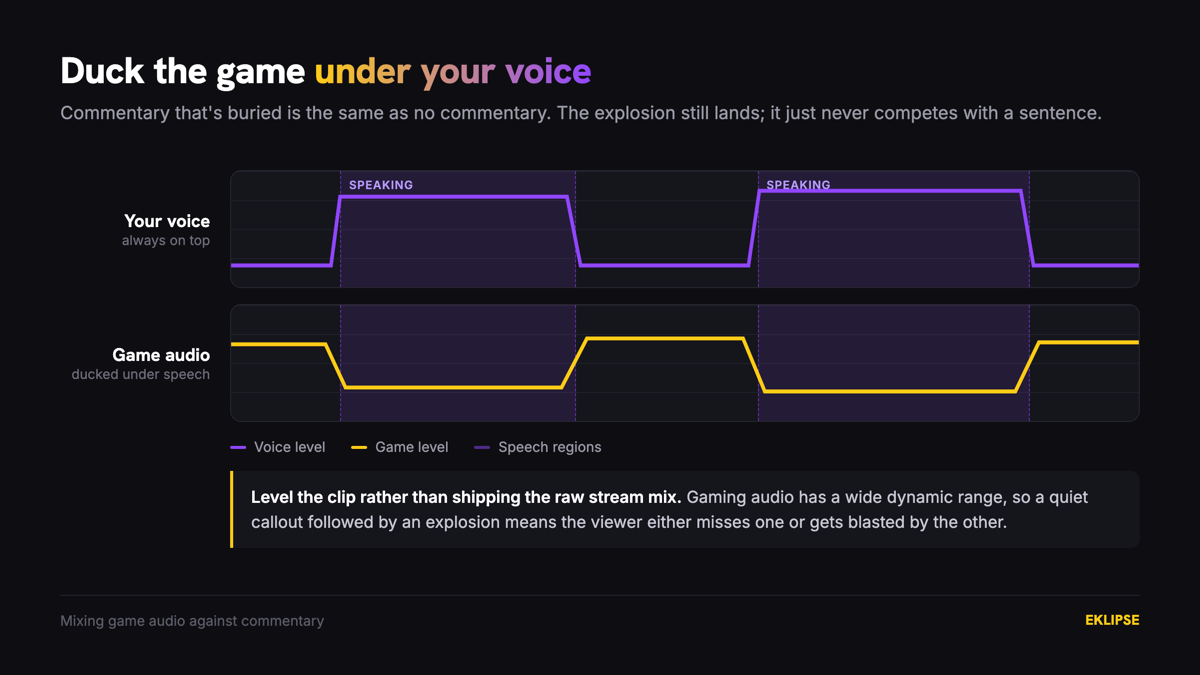
The fix: Boost your voice track by 3-5dB relative to game audio in vertical clips. Viewers need to hear you clearly. If they can’t, they swipe.

Quick EQ for mobile:

  • Voice: +3dB boost at 2-4kHz (clarity range)
  • Game audio: reduce by 3-5dB
  • Bass (below 100Hz): roll off (phone speakers can’t reproduce it)

Mistake 5: Neglecting the First Frame

The mistake: Letting the clip start on a loading screen, menu, or slow walk.

Reality: The first frame of your video is what appears in the feed before someone taps to watch. If the first frame shows a loading screen, a respawn timer, or a dark corner โ€” nothing signals to the viewer that this clip is worth watching.

The fix: Manually set the cover frame to the most visually interesting moment, or trim the clip to start at the action. The first frame should contain a crosshair, an enemy, an explosion, or your face reacting โ€” anything that signals “something is happening.”


Mistake 6: Vertical Video on Horizontal Platforms

The mistake: Posting a vertical clip on YouTube (not Shorts) or Twitter/X in its native vertical format, surrounded by black bars.

Reality: When you upload a 1080×1920 vertical video as a standard YouTube video (not a Short), it displays with massive black bars on desktop and tablet. Same on Twitter/X. It looks unprofessional and wastes screen real estate.

The fix: On YouTube, always upload vertical clips as Shorts (the platform handles vertical formatting). On Twitter/X, either post horizontal versions of your clips or accept the smaller display size.


Mistake 7: Not Centering Your Webcam for Vertical

The mistake: Using the same webcam position from your horizontal stream (bottom-left or bottom-right) in a vertical clip.

Reality: In horizontal video, the webcam sits in one of the corners. In vertical video, the corners are too far from the action zone. A webcam placed in the bottom-right of a vertical frame is far from the center gameplay.

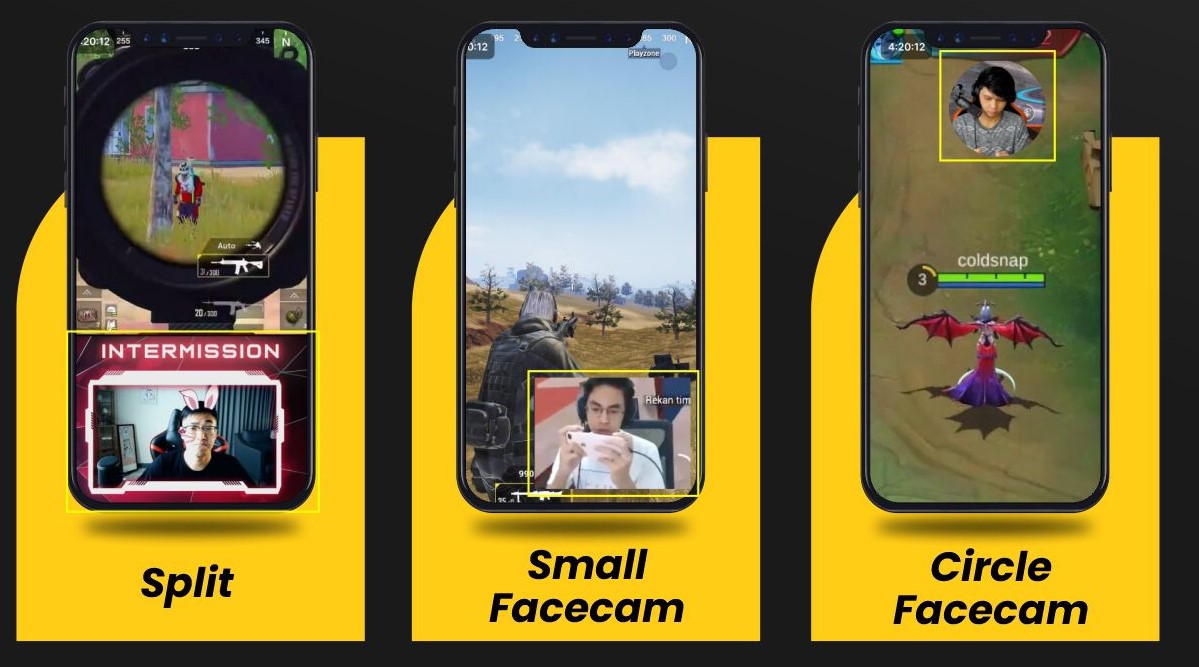
The fix: Reposition your webcam overlay for vertical clips:

  • Reaction clips: Top-center (face is the main focus)
  • Gameplay clips: Top-right (face supplements the action)
  • Tutorials: Bottom-center (keeps face close to any text/demonstrations)

Most clip makers (Eklipse included) handle webcam positioning automatically based on the clip content type.


Mistake 8: Over-Compression Artifacts

The mistake: Exporting at too-low bitrate for the platform, causing blocky artifacts in fast-motion gaming clips.

Reality: Gaming clips have rapid visual changes (gunfire, movement, particle effects). Low bitrate compression turns these into blocky, pixelated artifacts that look terrible on mobile screens.

The fix: Export at minimum 10 Mbps for 1080×1920 60fps gaming clips. Higher if the game has lots of particle effects or fast movement. H.264 codec is still the most compatible for all platforms.


Quick Checklist Before Posting

  • [ ] First frame has visual interest (crosshair, enemy, face, explosion)
  • [ ] Kill feed, minimap, or important HUD is visible (or not needed)
  • [ ] Voice is audible above game audio
  • [ ] No empty dead space at top/bottom of frame
  • [ ] Text is large enough to read on a phone screen
  • [ ] No platform watermarks (unless intended)
  • [ ] Clip is posted in correct format (not standard YouTube)
  • [ ] Bitrate is 10+ Mbps for fast-motion games

Bottom Line

Vertical video isn’t hard. But “good enough” mistakes compound into low watch time and high swipe rates.

If your clips are getting views but low completion rates, review this list. Odds are you’re making 1-3 of these mistakes without realizing it. Fix them, and your retention will improve more than any editing technique could achieve.

The Opportunity Cost of Manual Editing: What You’re Trading Away

0

When you spend 2 hours editing clips after a 4-hour stream, you’re not just spending time. You’re choosing NOT to spend that time on something else.

Economists call this opportunity cost: the value of the best alternative you gave up.

Most streamers never calculate what they’re trading away when they choose manual editing over auto-clipping. Here’s the full picture.


Direct Comparison: Manual vs Auto-Clipping

ResourceManual EditingAuto-ClippingDifference
Time per stream90 minutes15 minutes+75 min saved
Time per month (16 streams)24 hours4 hours+20 hours saved
Energy costHigh (cognitive)Low (binary decisions)Recoverable energy
Clips per stream4-68-15+4-9 clips
Posting consistencyInconsistent (burnout)Consistent (low effort)+40+ clips/month

The 20 hours per month you save is not just time. It’s capacity for growth activities.


What 20 Hours Per Month Can Buy

Option A: More Streaming (+40% more content)

20 hours = 5 additional 4-hour streams per month.

Growth impact: A streamer going from 16 streams/month to 21 streams/month gets more reps, more VODs, more clips, and more community touchpoints. More streams = more opportunities to grow.

Estimated CCV lift: +15-25% in 60 days (more reps = better streaming = more retention).

Option B: More Short-Form Content (2x current output)

20 hours = 120 additional clips per month (10 min each) or 40 additional clips per month (30 min each).

Growth impact: Going from 60 clips/month to 100-180 clips/month accelerates algorithm learning. More data points = faster content optimization.

Estimated reach lift: +50-100% in 60-90 days (more volume = more algorithm chances).

Option C: Community Building (Retention)

20 hours = deep community engagement.

What you could do:

  • Moderate and engage in Discord (5 hrs/week)
  • Plan community events (1 hr/week)
  • Respond to comments on all platforms (2 hrs/week)
  • Network with other streamers (2 hrs/week)

Growth impact: Higher retention = more regulars = more word-of-mouth growth.


The Compound Cost Over 12 Months

ResourceManual EditingAuto-Clipping12-Month Loss
Hours spent312 hours52 hours260 hours lost
Full work weeks7.8 weeks1.3 weeks6.5 weeks lost
Missed streams (opportunity)โ€”โ€”65 potential streams
Missed clips (opportunity)768 clips2,080 clips1,312 clips lost
Missed followers (est.)~1,600~4,000~2,400 followers lost
Missed sub revenue (est.)~$2,000~$5,000~$3,000 lost

Total cost of manual editing over one year: approximately $3,000 in lost revenue + 260 hours of life.


The Energy Cost

Time isn’t the only cost. Manual editing consumes energy that could be spent on higher-value work.

Energy StateAfter 4-hr Stream + Manual EditAfter 4-hr Stream + Auto-Clip
CognitiveDepletedFunctional
CreativeDepletedAvailable
SocialDepletedAvailable
PhysicalLowModerate
Next-day energyReduced (sleep + recovery)Full (normal recovery)

The hidden cost: Manual editing reduces your capacity for everything else the next day. A streamer who edits for 2 hours after streaming gets poorer sleep, lower next-day productivity, and cumulative fatigue that compounds over weeks.


The 3-Year Cost

ResourceManual (3 Years)Auto-Clip (3 Years)
Hours spent editing936 hours156 hours
Clips produced~2,300~6,240
Estimated followers gained~4,800~12,000
Estimated revenue (subs)~$6,000~$15,000
Hours available for growth0 (all used for editing)780 hours
Estimated channel growthSteady (capped by time)Accelerated (time reinvested)

The Decision Framework

When you choose manual editing, you are choosing:

Manual editing:

  • +90 min per stream of low-enjoyment, high-effort work
  • +4-6 clips per stream
  • Higher burnout risk
  • No extra capacity for growth activities

Auto-clipping:

  • +15 min per stream of review + posting
  • +8-15 clips per stream
  • Lower burnout risk
  • +75 min per stream for growth activities

What Streamers Actually Do With the Time

Based on surveys of streamers who switched from manual to auto-clipping:

Activity% Who Spend Time HereGrowth Impact
More streaming49%Direct (more content)
Community engagement31%Retention (indirect)
Content strategy/planning28%Compound (direct)
Networking/collabs22%Direct (new audiences)
Rest/recovery18%Indirect (sustainability)
Learning/improving15%Compound (long-term)

The plurality reinvest the time into more streaming โ€” which creates more content, which feeds the growth loop.


The Real Question

The question isn’t “should I spend 2 hours editing?”

The question is: “What else could I do with 20 hours per month that would grow my channel more than manual editing does?”

For most streamers, the answer is: anything else. Streaming more, creating more content, engaging your community, networking with other creators โ€” all of these have higher ROI than the manual editing you could automate.


Bottom Line

Manual editing costs 260 hours per year. That’s 65 potential streams. 1,300 potential clips. $3,000 in potential revenue.

The opportunity cost of not automating is higher than most streamers realize โ€” because they’ve never calculated what they’re trading away.

If auto-clipping saves you 75 minutes per stream, that’s 75 minutes per stream you can reinvest into activities that actually grow your channel. Over a year, that reinvestment compounds into significantly more growth than manual editing ever could.

TikTok Caption Length: How Many Characters Actually Work for Gaming Clips?

0

You spend 5 minutes editing a clip. Then you write a caption in 10 seconds without thinking about it.

Most streamers do this. It’s a mistake. The caption is the second-most-important element of your post โ€” after the clip itself.

The length, structure, and placement of your TikTok caption directly affects how many people watch, follow, and click your Twitch link. Here’s what the data says about optimal caption length for gaming content.


How TikTok Captions Work

TikTok captions have a visible preview and a hidden full text:

  • Visible preview: The first ~100-150 characters (varies by device and font size)
  • Full text: Up to 2,200 characters (accessed by tapping “more”)

The visible preview is the only part that matters for engagement. If the first 100 characters don’t hook the viewer, they won’t tap “more” to read the rest.


Optimal Caption Length by Goal

GoalOptimal LengthWhy
Maximize watch time80-120 charactersShort enough to read in 2 seconds. Keeps focus on the video.
Maximize profile visits100-150 charactersEnough space for game + moment type + CTA
Maximize comments120-200 charactersRoom for a question at the end that invites replies
Maximize follows80-120 characters + CTAShort caption with clear “follow for more” directive
Drive Twitch clicks100-150 charactersGame + moment + CTA + link direction

Recommended all-purpose length for gaming clips: 100-140 characters.


The 3-Part Gaming Caption Structure

[Line 1: Hook โ€” game + moment type] (40-60 chars)
[Line 2: CTA or context] (40-60 chars)
[Line 3: Hashtags] (optional, 3-5 tags)

Example 1: Gameplay Clip

1v3 clutch in Valorant โ€” they never saw it coming ๐ŸŽฏ
Catch me live M/W/F 7PM EST
#valorant #clutch #gaming #fyp

Character count: 109 visible. Game identified. Moment described. Schedule given. Hashtags separate.

Example 2: Reaction Clip

My reaction when chat sends me to the worst drop spot ๐Ÿ’€
I should have known better. Full stream on Twitch.
#gaming #funnymoments #twitch #valorantclips

Character count: 138 visible. Hook in first 40 chars. CTA in line 2.

Example 3: Tutorial Clip

This loadout got me 20 kills in ranked. Try it yourself.
Full settings guide on my Twitch โ€” link in bio.
#gamingtips #valorant #warzone #fyp

Character count: 123 visible. Value proposition in first line.


Caption Length Anti-Patterns

The Novel (300+ characters)

“I was playing Valorant with my friends and we decided to queue ranked because the last game went really well and then this happened I can’t believe itโ€ฆ”

Problem: Nobody reads this before the video ends. The hook is buried.

Fix: Cut to 100-140 characters. Save the story for the video.

The Empty Caption

#valorant #clutch #gaming #fyp #viral #streamer

Problem: No text hook. No CTA. The algorithm has less context about what the clip is about.

Fix: Add 1-2 lines of caption text before hashtags. Algorithm uses caption text for content classification.

The Over-Stuffed

“1v3 clutch valorant ranked gameplay insane clutch moment funny reaction gaming content stream highlights watch until the end like and subscribe for more content follow my twitch link in bio #valorant #clutch #gaming”

Problem: Everything crammed into one sentence. No line breaks. Looks like keyword spam.

Fix: Line breaks after the first sentence (40-60 chars). Let the caption breathe.


Line Break Strategy

Line breaks significantly improve caption readability. A caption that’s broken into 2-3 short lines gets higher engagement than a single block of text.

Bad (no breaks):
“1v3 clutch in Valorant โ€” they never saw it coming catch me live M/W/F 7PM EST #valorant #clutch #gaming #fyp”

Good (with breaks):

1v3 clutch in Valorant โ€” they never saw it coming ๐ŸŽฏ

Catch me live M/W/F 7PM EST

#valorant #clutch #gaming #fyp

How to add line breaks in TikTok:
Type your caption. Press Enter/Return twice between each line. TikTok preserves single line breaks in the caption field.


Caption Length by Content Type

Content TypeOptimal LengthExample Structure
Gameplay highlight80-120 charsMoment + game + CTA
Funny moment100-140 charsSetup + punchline + CTA
Tutorial/tip120-160 charsValue prop + benefit + CTA
Reaction clip100-130 charsReaction + context + CTA
Challenge clip100-140 charsSetup + outcome + CTA
Montage/compilation80-100 charsTheme + “best of” + CTA

The TikTok Algorithm and Captions

TikTok’s algorithm uses captions to understand what your content is about. Relevant keywords in your caption help the algorithm categorize and distribute your content to the right audience.

Keywords to include:

  • Game name (Valorant, Fortnite, COD, Apex)
  • Moment type (clutch, 1v3, squad wipe, fail, funny)
  • Platform (Twitch, streamer, live)

Don’t keyword-stuff. Natural inclusion in a readable caption is better than forced keywords. “1v3 clutch in Valorant” is natural. “Valorant clutch gaming twitch streamer funny” is keyword-stuffed.


CTA Placement in Captions

The CTA (call to action) should go at the end of the visible preview or in the second line after a line break.

Best CTA positions:

PositionEffective?Reason
First lineโš ๏ธ SometimesBetter to hook with the moment first
Second line (after break)โœ… BestMoment hook โ†’ CTA โ†’ Hashtags
At the very end (after hashtags)โŒ NoNobody scrolls past hashtags

Testing Caption Length

Simple A/B test:

  1. Post 10 clips with short captions (80-100 chars)
  2. Post 10 clips with medium captions (120-150 chars)
  3. Compare average views, watch time, and profile visits

Do this over 2-3 weeks and you’ll know exactly what length your specific audience prefers. Most gaming audiences prefer shorter captions โ€” they want to watch the clip, not read a paragraph.


Bottom Line

Keep gaming clip captions between 100-140 characters. Three lines max: hook, CTA, hashtags. Line breaks after each section.

The caption is not the place to tell a story. The clip is the story. The caption just needs to tell people what they’re watching and what to do next.

Write the caption before you post. Read it out loud. If it takes longer than 5 seconds to read, cut it down.

Smart Reframing vs Center Crop: What Actually Works for Gaming Clips

0

When you convert a horizontal gaming clip to vertical video, you have two choices:

  1. Center crop โ€” Take the center 1080×1920 pixels of the 1920×1080 frame
  2. Smart reframing โ€” Let AI track the action and crop dynamically

Most streamers use center crop because it’s fast. But for gaming content, center crop destroys critical information. Smart reframing preserves context. Here’s the direct comparison.


The Problem With Center Crop

A center crop takes the middle of your horizontal frame and removes everything outside it.

โ”Œโ”€โ”€โ”€โ”€โ”€โ”€โ”€โ”€โ”€โ”€โ”€โ”€โ”€โ”€โ”€โ”€โ”€โ”€โ”€โ”€โ”€โ”€โ”€โ”€โ”€โ”€โ”€โ”€โ”€โ”€โ”€โ”€โ”€โ”€โ”€โ”€โ”€โ”€โ”€โ”€โ”€โ”
โ”‚                                         โ”‚
โ”‚  [Kill Feed]    CROSSHAIR    [Minimap]  โ”‚
โ”‚                                         โ”‚
โ”‚          โ”Œโ”€โ”€โ”€โ”€โ”€โ”€โ”€โ”€โ”€โ”€โ”€โ”€โ”€โ”€โ”€โ”€โ”€โ”            โ”‚
โ”‚          โ”‚   CENTER CROP   โ”‚            โ”‚
โ”‚          โ”‚  (1080x1920)    โ”‚            โ”‚
โ”‚          โ””โ”€โ”€โ”€โ”€โ”€โ”€โ”€โ”€โ”€โ”€โ”€โ”€โ”€โ”€โ”€โ”€โ”€โ”˜            โ”‚
โ”‚                                         โ”‚
โ”‚  [Health]  [Ammo]  [Ability Bar]        โ”‚
โ”‚                                         โ”‚
โ””โ”€โ”€โ”€โ”€โ”€โ”€โ”€โ”€โ”€โ”€โ”€โ”€โ”€โ”€โ”€โ”€โ”€โ”€โ”€โ”€โ”€โ”€โ”€โ”€โ”€โ”€โ”€โ”€โ”€โ”€โ”€โ”€โ”€โ”€โ”€โ”€โ”€โ”€โ”€โ”€โ”€โ”˜

What survives center crop:

  • Crosshair (center)
  • Enemy models (typically center)
  • Your immediate aim point

What center crop removes:

  • Kill feed (top-right) โ€” viewer doesn’t know who you killed
  • Minimap (bottom-left) โ€” viewer doesn’t know positioning
  • Health/ammo (bottom corners) โ€” viewer doesn’t know how close the fight was
  • Ability cooldowns (bottom center) โ€” viewer doesn’t know what abilities are available

Result: The clip shows the kill, but the viewer has no context for how significant it was, where you were on the map, or how close you were to dying.


What Smart Reframing Does

Smart reframing uses AI to analyze each frame and adjust the crop region to follow the action.

Frame 1: Crosshair at center-left (peeking corner)
  โ†’ Crop shifts left: keeps crosshair + enemy + some kill feed

Frame 2: Crosshair at center-right (tracking enemy)
  โ†’ Crop shifts right: keeps crosshair + enemy + some minimap

Frame 3: Looking down (checking body)
  โ†’ Crop shifts down: keeps crosshair + health bar

The crop is dynamic. It follows the action rather than staying fixed on the dead center.


Head-to-Head: Gaming Clip Comparison

ElementCenter CropSmart ReframingWhy It Matters
Crosshairโœ… Always visibleโœ… Always visibleCore aiming
Enemy modelsโœ… Usually visibleโœ… Always trackedThe action
Kill feedโŒ Croppedโš ๏ธ Partial (edge tracking)Context
MinimapโŒ Croppedโš ๏ธ Sometimes visiblePositioning context
Health/ammoโŒ Croppedโœ… Kept when relevantTension
Ability barโŒ Croppedโœ… Kept when relevantGame knowledge

Smart reframing wins for gaming content because it preserves more contextual information. The gap is most noticeable in clips where positioning, health, or kill feed context matters to the entertainment value.


When Center Crop Is Good Enough

Center crop works fine when:

  • Close-quarters combat โ€” Most of the action is already center-frame
  • No critical UI elements in the corners โ€” Some games have minimal HUD
  • Reaction clips โ€” The focus is your face (webcam), not the HUD
  • Short clips (<15 seconds) โ€” Not enough time to notice missing context

When Smart Reframing Is Essential

Smart reframing matters most when:

  • Long-range engagements โ€” Enemies at frame edges, crosshair at edges
  • Position-heavy games โ€” Minimap context is crucial (Battle Royales, tactical shooters)
  • Comeback clips โ€” Low health makes the clip exciting; health bar context matters
  • Multi-kill sequences โ€” Kill feed context tells the story of sequential eliminations

Tools Comparison

ToolSmart ReframingQualityEase of Use
Eklipseโœ… AI smart reframing (auto)Excellent โ€” gaming-trained0 effort (auto-applied)
Premiere Proโœ… Auto Reframe effectGood โ€” general purposeManual apply per clip
CapCutโŒ Center crop onlyN/AManual keyframe tracking
DaVinci ResolveโŒ Manual keyframes onlyN/AHigh effort

Eklipse applies smart reframing automatically to every detected clip โ€” no configuration needed. Premiere Pro has Auto Reframe but requires applying the effect manually. CapCut and DaVinci require manual keyframe tracking, which is impractical for daily clip volume.


The Manual Alternative: Keyframe Tracking

If your tool doesn’t have smart reframing, you can manually track the action with keyframes:

  1. Set a starting crop position centered on the crosshair
  2. Move to the end of the clip
  3. Adjust crop position to where the crosshair ended
  4. The editor interpolates the movement between keyframes

Time cost: 3-5 minutes per clip. Worth it for special clips. Not sustainable for daily volume.


The Bottom Line

Center crop is fast but destroys gaming context. Smart reframing preserves it.

For daily clips, use a tool with auto smart reframing (Eklipse) โ€” it applies the best crop for each frame without any manual work. For special clips, manual reframing with keyframes gives you full control.

Never center crop a gaming clip where positioning, health, or kill feed matter to the story. The viewer can’t read your mind. If they can’t see the minimap, they don’t know how impressive your position hold was.

Time Audit Template for Streamer Content Creation

0

Most streamers don’t know how long they actually spend on content creation. They guess “about an hour” when the real number is closer to two. That gap between perception and reality is why content creation feels unsustainable โ€” you’re spending more time than you think.

A time audit fixes that. Here’s a template to track exactly where your content creation time goes.


Why You Need a Time Audit

Without data, every decision is a guess.

Common ClaimReality (After Audit)
“I spend an hour editing”Actually 1.5-2 hours (including distractions)
“I post 3 clips per stream”Actually post 1-2 because “editing takes too long”
“I’d post more if I had time”Actually have 4+ unprocessed VODs in the backlog

A time audit tells you where your time actually goes, so you know what to automate, delegate, or cut.


The Template

Track these activities for 14 days (2 weeks, minimum 4-6 streams):

Daily Content Time Log

DateStream DurationActivityStart TimeEnd TimeTotal MinNotes
VOD scrubbing
Clip trimming
Captions
Vertical formatting
Title writing
Uploading/posting
Engaging with comments
Total

What to Track

Core Content Creation Tasks

VOD scrubbing: Time spent watching the VOD at 1.5-2x speed looking for highlights. Include time rewatching clips you’re unsure about.

Clip trimming: Time spent in editing software trimming start/end points, cutting dead space, and adjusting clip length.

Captions: Time spent adding, generating, or editing captions. Include time fixing AI caption errors.

Vertical formatting: Time spent cropping to 9:16, adjusting crop region, positioning webcam, and setting export resolution.

Title/Caption writing: Time spent writing the post title, caption text, and choosing hashtags.

Uploading: Time spent uploading to each platform, writing descriptions, and scheduling.

Non-Creation But Related

Comments: Time spent replying to comments on posted clips. This is community engagement, not content creation โ€” track it separately.

Analytics review: Time spent checking views, watch time, and traffic sources. Limit to 5 min/day.

Planning: Time spent deciding what to post, what format to use, or what content to create next.


Weekly Summary Sheet

At the end of each week, total the numbers:

ActivityWeek 1 MinWeek 2 MinAverage Min/WeekAverage % of Total
VOD scrubbing– %
Clip trimming– %
Captions– %
Vertical formatting– %
Title writing– %
Uploading/posting– %
Total creation100%
Comments
Analytics
Planning

How to Analyze Your Audit

Find the Bottleneck

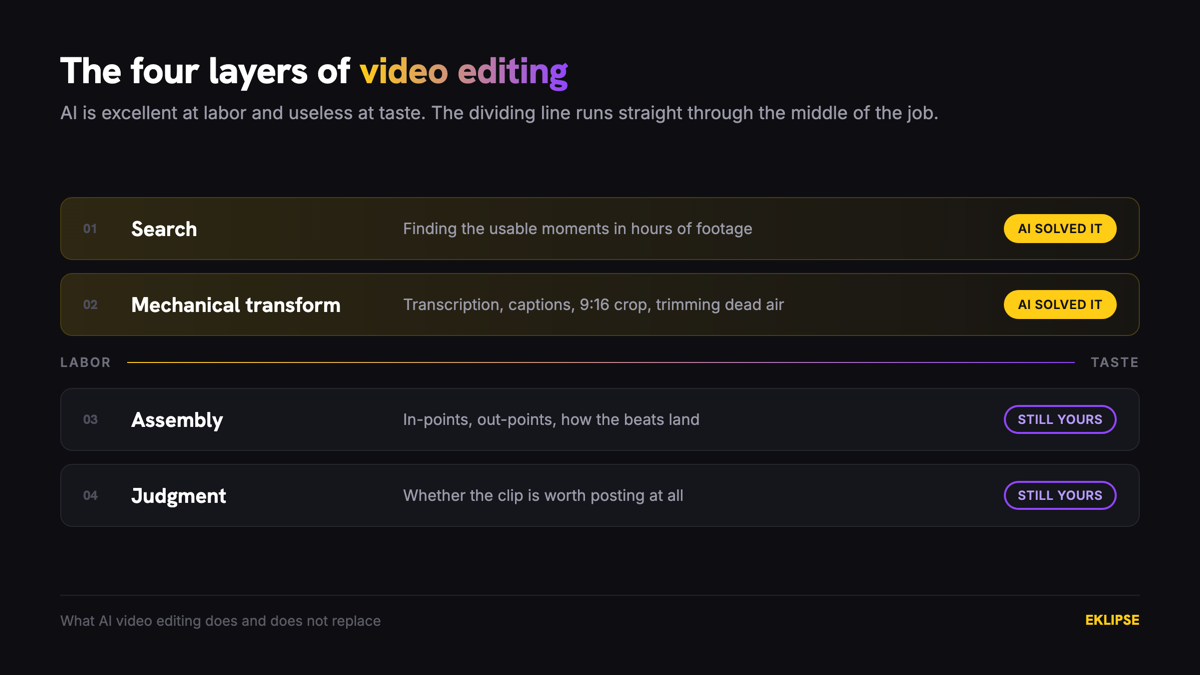
Which activity takes the most time? For most streamers, it’s VOD scrubbing (35-50% of total editing time).

If VOD scrubbing is your #1 time sink: Auto-clipping eliminates this entirely. Non-negotiable change.

If clip trimming is your #1 time sink: Your detection method is returning poorly-trimmed clips. Either switch to a tool that trims better, or adjust your trimming standards (clips don’t need perfect trimming for daily posts).

If captions is your #1 time sink: Switch to a tool with auto-captions or batch caption processing. Manual captions are not sustainable at volume.

Calculate Your Hourly Rate

Total editing hours per month รท total clips posted = hours per clip.

If you’re spending 45+ minutes per clip and the clips average 500 views, your “time per view” ratio is terrible. Every clip should be under 15 minutes of work for daily content.

The 50% Rule

If any single activity takes more than 50% of your total editing time, that activity is the bottleneck. Fixing it will save more time than optimizing everything else combined.


The Post-Audit Decision Matrix

After 14 days of tracking, categorize each activity:

ActivityTime %EnjoymentAutomatable?Action
VOD scrubbing40%Lowโœ… YesAutomate (Eklipse)
Captions20%Lowโœ… YesAuto-captions (Eklipse)
Clip trimming15%Lowโœ… YesAutomate (Eklipse)
Vertical format10%Lowโœ… YesAutomate (Eklipse)
Title writing10%MediumโŒ NoKeep, optimize
Engaging comments5%HighโŒ NoKeep

Result: Automate everything that’s low-enjoyment and automatable. Keep everything that’s high-enjoyment or requires human judgment.


Before and After: What the Numbers Look Like

Before Audit (Manual Editing)

ActivityMinutes per Stream
VOD scrubbing40
Clip trimming15
Captions10
Vertical formatting10
Title writing5
Uploading10
Total90 min
Clips produced:4
Min per clip:22.5

After Audit (Auto-Clipping)

ActivityMinutes per Stream
Review clips5
Title writing3
Uploading10
Total18 min
Clips produced:9
Min per clip:2

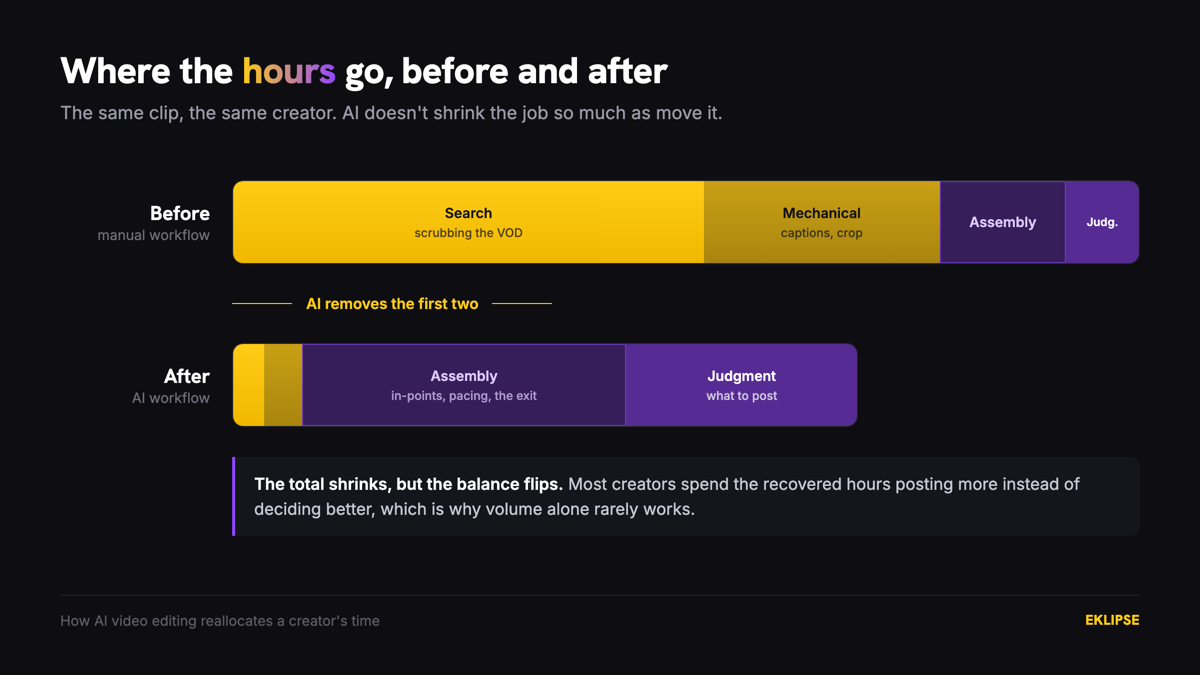
Time saved per stream: 72 minutes. Clips produced: 2.25x more.


The Template File

Copy this into a spreadsheet or notebook:

STREAM DATE: _______________
STREAM LENGTH: _______________

CONTENT CREATION TIME LOG
VOD scrubbing: ___ min
Clip trimming: ___ min
Captions: ___ min
Vertical formatting: ___ min
Title/caption writing: ___ min
Uploading/posting: ___ min
Engaging comments: ___ min
Analytics: ___ min
Planning: ___ min

TOTAL CREATION TIME: ___ min
CLIPS POSTED TODAY: ___

NOTES:
- What took longer than expected?
- What could be automated?
- What felt like wasted effort?

Bottom Line

A 14-day time audit reveals exactly where your content creation time goes. The result is usually surprising โ€” most streamers spend 40-50% of their editing time on tasks that could be automated.

If VOD scrubbing and manual formatting are your biggest time sinks (they are for most streamers), auto-clipping is the single change that saves the most time. Run the audit. You’ll see the numbers yourself.