Home Blog Page 4

How Small Streamers Grow by Posting Clips Consistently

0
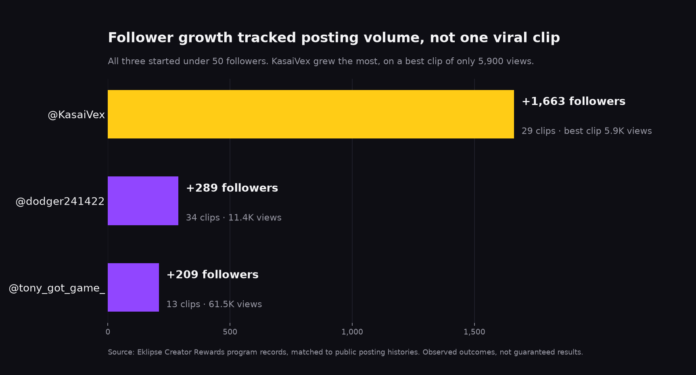
Bar chart: KasaiVex gained 1,663 followers from 29 clips despite a best clip of 5,900 views, far more than dodger241422 (+289) and tony_got_game_ (+209).

How Small Streamers Grow by Posting Clips Consistently

You have been chasing the same number all year: a thousand subscribers, four thousand watch hours, the line where YouTube finally starts paying you back for the streams. Maybe you were almost there. Then the line moved.

YouTube raised the bar to get into its Partner Program, doubling the watch hours a channel needs before it earns ad money, and its Shorts payout pool now expects creators to average views in the millions just to stay eligible. If you run a small channel, the finish line you were sprinting toward got picked up and set down somewhere further off. The frustration you feel is not only yours; the creators you follow are posting the same thing.

So here is the part worth knowing before you write off getting paid for your clips. Not every program hides income behind a subscriber count. View-based rewards pay on the accumulated views your clips earn, and nothing else. A channel at 47 followers qualifies the same as one at 47,000. KasaiVex started near the bottom of that range, never had a single clip pass 6,000 views, and still finished one program cycle at 1,710 followers with cash in hand. This is not a replacement for YouTube monetization, and it doesn’t pretend to be. It is money that doesn’t wait for you to clear a bar someone else keeps raising, and the way you reach it is refreshingly boring: post a clip every stream, and let the views stack.

Key Takeaways
– YouTube raised its Partner Program bar; view-based reward programs pay small creators on clip views, with no subscriber or watch-hour gate to clear first.
– Follower growth in the tracked cases tracked posting volume, not clip virality: the biggest gainer’s best clip reached only 5,900 views.
– @KasaiVex posted 29 clips and grew from 47 to 1,710 followers; @dodger241422 posted 34 clips and grew from 48 to 337; @tony_got_game_ posted 13 and grew from 4 to 213.
– The bottleneck small creators hit is the manual editing-and-posting workload, which makes daily posting unsustainable long before audience size is the problem.
– Content Agent, the autonomous workflow built on Eklipse’s AI clip maker, removes that workload by pulling your top moments per stream, formatting them to 9:16 with captions, and posting on your approval.
– These are observed outcomes from one documented program cycle, not guaranteed results; growth varies by creator and clip.


The second job that kills consistency

Ask a small streamer why they don’t post more clips and you rarely hear “I can’t find good moments.” You hear that reviewing the VOD, picking the moments, reframing them to vertical, and writing captions takes longer than the stream did. So it happens once, maybe twice, then stops.

That’s the real enemy of a small channel. Consistency is a workload problem, and the workload beats you before the audience ever gets a chance to.

The math is unforgiving in the other direction, too. Short-form platforms reward frequency. A creator posting once a week gives TikTok and Shorts seven times fewer chances to surface their content than a creator posting daily. Every stream you don’t clip is discovery you’re leaving on the table, and small channels can’t afford to leave any.

So the question that decides growth is a plain one: how do I post every single stream without burning out? Solve that, and the views take care of themselves.

How Content Agent keeps the posting from dying

Content Agent is the autonomous workflow built on Eklipse’s AI clip maker. Its whole job is to take the four manual steps that kill consistency and do them for you, so posting after a stream costs one tap instead of an hour.

The loop is four steps from the tool and two decisions from you.

Step 1: it hunts. After every stream it scans your full Twitch or Kick VOD and pulls your top three moments, the kills, clutches, and hype spikes. You don’t scrub the VOD looking for them.

Step 2: it explains the pick. Each clip comes with a plain-English reason, including how strong the hook is and whether it fits TikTok or Shorts better. You see the logic before you approve, so you’re not posting blind.

Step 3: it captions and times. Captions get generated, and the best posting time per platform is calculated. Adjust anything or leave it as-is.

Step 4: you approve, it posts. One tap sends the clip to TikTok, YouTube Shorts, and Reels, including on the busy days when you’d otherwise post nothing.

Forget whether the AI is clever. What matters is that it moves posting from “an hour of work I’ll skip” to “a decision I make in ten seconds.” That shift is the entire difference between posting once and posting every stream. For creators who want to space those posts out across the week instead of dumping them at once, scheduling through Eklipse spreads the same clips across days without extra effort.

Three hours of streaming turns into a month of posted content, because the part that used to stop you no longer does.
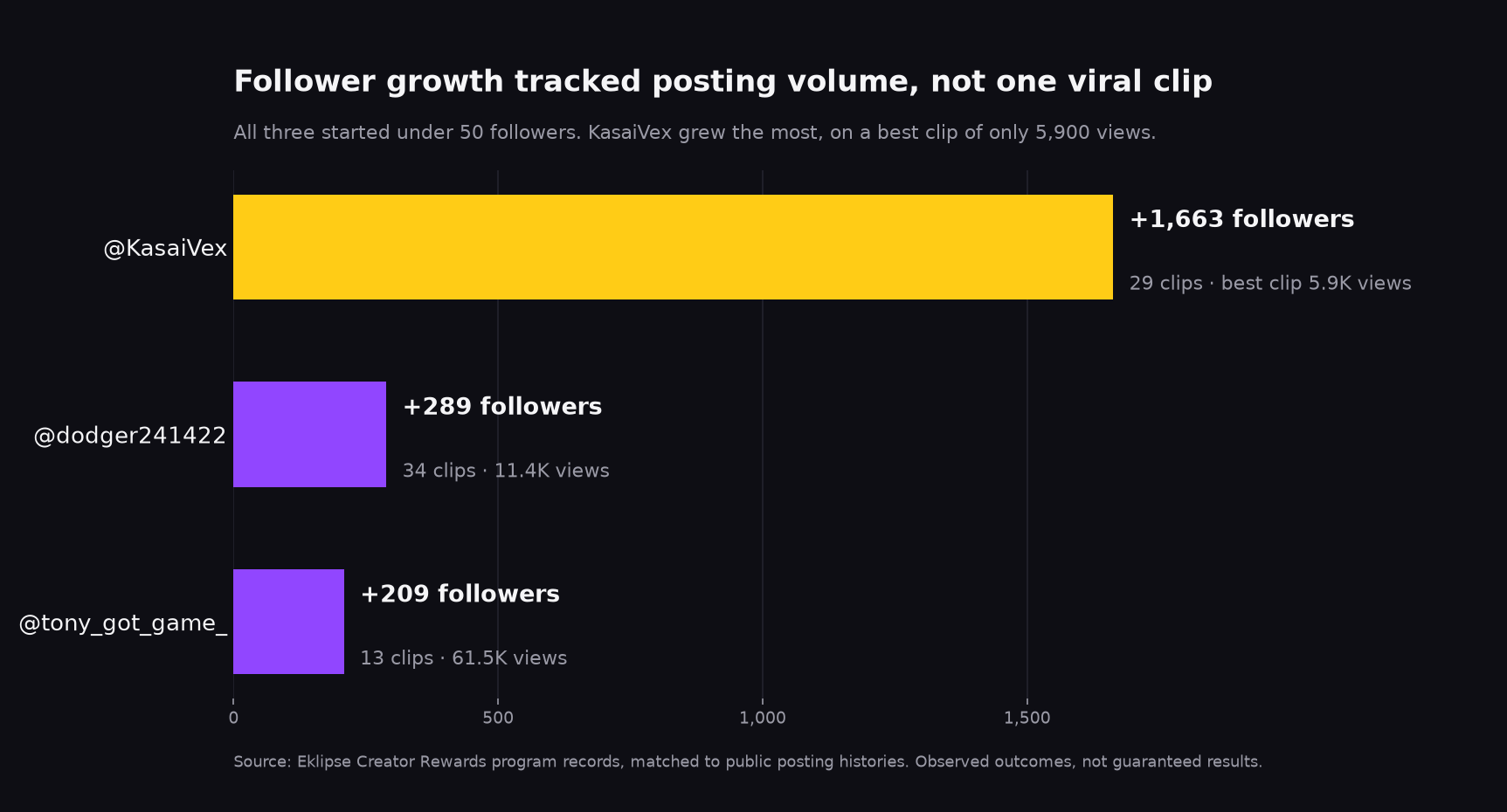
Bar chart: KasaiVex gained 1,663 followers from 29 clips despite a best clip of 5,900 views, far more than dodger241422 (+289) and tony_got_game_ (+209).

What consistency actually produced

Here’s what “post every stream” looked like for three real accounts, all starting below 50 followers, over one documented program cycle. The numbers come from Eklipse’s program records matched against each creator’s public posting history.

Creator Clips posted Views Follower growth
@tony_got_game_ 13 61,500 total 4 โ†’ 213 (+209)
@dodger241422 34 11,400 total 48 โ†’ 337 (+289)
@KasaiVex 29 best clip 5,900 47 โ†’ 1,710 (+1,663)

Read those rows slowly, because they don’t say what most “grow your channel” advice says.

Tony posted the fewest clips (13) and pulled the most views (61,500), and grew a solid 209 followers from a standing start of 4. A clean result: post consistently and the views bring followers.

Dodger posted the most clips (34) for modest views (11,400) and still added 289 followers. Volume alone, even without big view counts, moved the number.

Then KasaiVex, who is the whole argument. Their best-performing clip reached 5,900 views. Not one clip went viral. And they grew by 1,663 followers, more than the other two combined, off 29 consistently posted clips. No breakout. Just showing up 29 times.

Why modest clips beat waiting for a viral one

The KasaiVex case is worth sitting with, because it inverts the advice most small streamers are given. The common belief is that growth is a lottery: keep swinging until one clip hits, then ride it. Under that model, a creator whose best clip only reached 5,900 views “failed” to go viral.

Except they grew the most. The driver was the compounding of many modest clips: 29 posts, each landing a few hundred to a few thousand views, each one a fresh surface where a new viewer can find you and follow.

Frequency builds an audience that a single 100,000-view fluke often doesn’t. A viral spike brings watchers who came for one clip and leave. Steady posting brings people who see you three or four times, recognize the channel, and hit follow. On TikTok and Shorts, that repeated exposure is worth more to a small account than one big number, because the platforms keep showing your next clip to people who engaged with the last.

This is the part that’s good news for a small account. You don’t need to manufacture a viral moment, which no one knows how to do on command anyway. You need to post the decent moments you already have, every stream, for a month. The problem isn’t finding those moments. It’s having the time to turn them into posts.

An honest caveat, stated the way it should be: these are observed outcomes from one cycle, not guaranteed results, and no one can prove Eklipse alone caused the follower growth. What the three cases do establish is a pattern worth betting on, that steady posting from a tiny base produced measurable growth, and the biggest gainer never went viral.

Where this works, and where it doesn’t

This approach fits active Twitch and Kick streamers who run regular sessions and whose content has clear peaks: FPS, battle royale, anything with kills, clutches, and reaction moments. That’s where the AI finds clean clips and where frequent posting compounds fastest.

It’s a weaker fit in two spots. If you don’t stream on Twitch or Kick, there’s no VOD for the tool to scan. And if you’re a Just Chatting or slow-strategy streamer, the detection leans toward action events, so it surfaces fewer obvious moments in talk-first content. The tool is tuned for gameplay peaks, and that’s where the consistency-to-growth loop runs cleanest.

If your content has those peaks and you’re just not posting them, that’s the exact gap this closes.

Growing a small streaming channel, answered

What actually grows a small streaming channel?
Consistent posting, more than viral clips. In three tracked cases starting under 50 followers, growth tracked how many clips each creator posted, not how many views any single clip got. The biggest gainer added 1,663 followers with a best clip of only 5,900 views.

How often should I post clips to grow?
Every stream. Short-form platforms reward frequency, and each post is a new chance to be discovered. The creators who grew most in the tracked cycle posted 29 and 34 clips, not one or two “perfect” ones.

Do I need a clip to go viral to grow?
No. The strongest growth case never had a clip pass 6,000 views. Many modest clips compounded into more follower growth than a single viral hit typically delivers, because frequency creates repeated discovery.

How does Content Agent help me post consistently?
It removes the four manual tasks that make daily posting unsustainable: reviewing the VOD, selecting moments, reframing to vertical, and captioning. It pulls your top three moments per stream, formats and captions them, and posts to TikTok, Shorts, and Reels on your one-tap approval.

Can you get paid for clips without YouTube monetization?
Yes. View-based reward programs pay on the accumulated views your clips earn, with no subscriber count or watch-hour requirement to clear first. That keeps them reachable for small creators locked out by the Partner Program’s raised thresholds. The clips still have to be posted through the program’s tool to count.

Is the AI clip maker free?
Content Agent is a paid Eklipse feature. Creating an account is free, but the clip-generation engine that produces the posts is part of the paid product.

Does this work for Kick streamers?
Yes. The tool scans Twitch and Kick VODs the same way, and posts from either platform build the same posting habit. Kick streamers run the clip flow through Eklipse’s Kick clip tool.

The pattern worth copying

Three creators, all starting under 50 followers, all growing, and the through-line isn’t luck:

  • Growth tracked posting volume, not viral reach. The biggest gainer’s best clip barely cleared 5,000 views.
  • The thing that stops small creators from posting consistently is the editing workload, not a lack of good moments.
  • Removing that workload turns “I’ll clip that later” into a clip posted every stream, which is what moves the follower count.

You don’t need a breakout clip. You need to post the good-enough ones every time you stream, and let the tool handle the part that used to stop you.
Try Eklipse and start posting every stream.

Gaming commentary: how to add it to your gaming clips

0
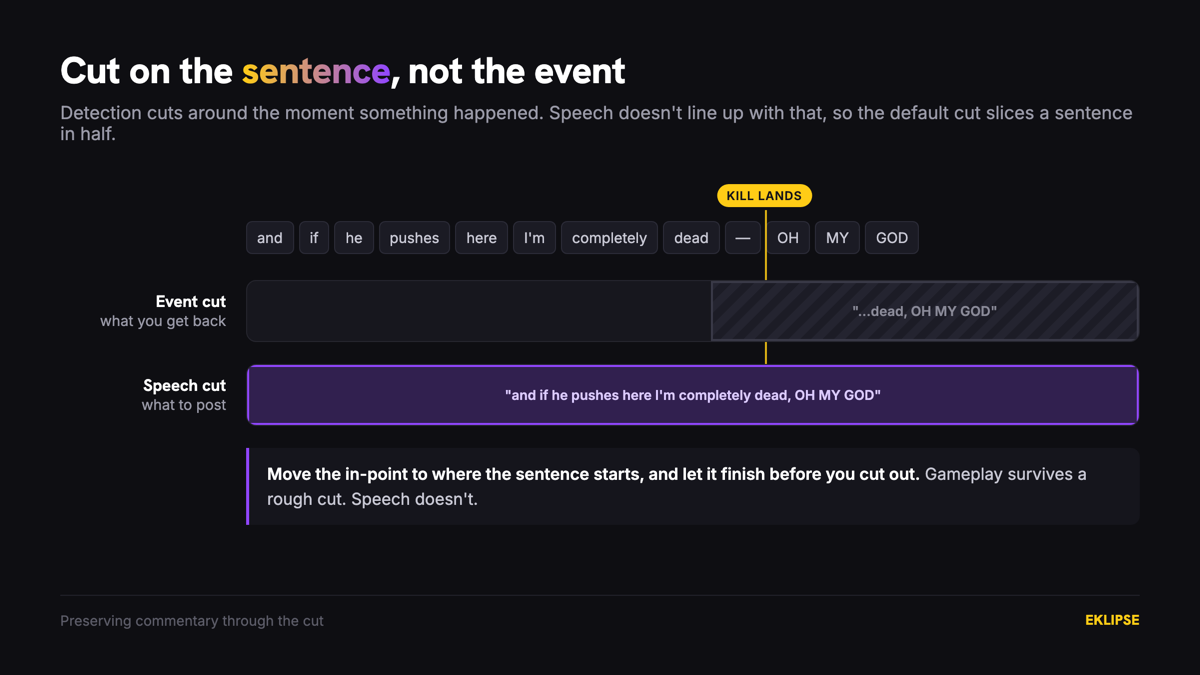
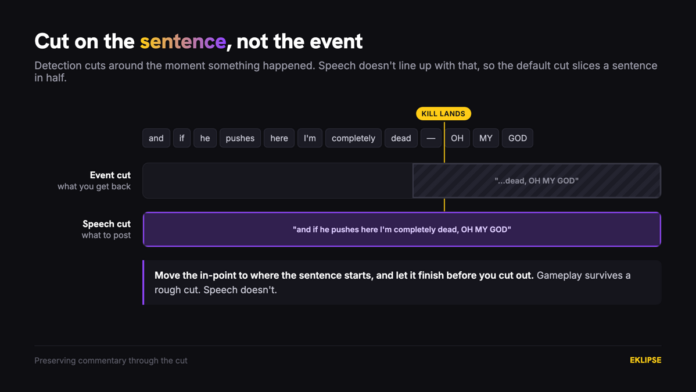
Timeline showing an event-based cut slicing a sentence in half versus a speech-boundary cut that keeps the full commentary
Cut on the sentence, not the event

Gaming commentary: how to add it to your gaming clips

If you streamed the footage, your gaming commentary already exists. You were talking the entire time, so the job isn’t recording a voiceover, it’s keeping what you said intact through the cut and making it readable with the sound off.

That reframe saves most streamers an entire production step they were about to add for no reason.

There’s a second case, and it’s the one people usually mean: silent gameplay you captured without a mic, where commentary genuinely has to be recorded after the fact. That’s real work, no AI does it for you, and this guide covers it too.

What changed recently is detection. Eklipse’s newer engine scores what you said as signal rather than treating audio as noise around the gameplay.


Key takeaways
– Streamed footage already contains your commentary; recorded gameplay doesn’t, and the two need completely different workflows
– Eklipse’s engine scores conversational signal, so Just Chatting bits, IRL segments, and podcast moments now get clipped alongside kills
– The most common failure is a cut that slices a sentence in half, because detection cuts on the event and not on the sentence boundary
– Most short-form is watched on mute, so burned-in word-by-word captions are what actually delivers commentary to viewers
– No AI tool writes or performs commentary for you; voiceover is still a manual recording job


Two kinds of gaming commentary, and only one needs recording

These get conflated constantly, and the confusion costs people hours.

Live commentary is what you said while playing. It’s already in the VOD, timestamped, in sync, and reacting to something real. Your work is preservation.

Added commentary is a voiceover recorded over footage after the fact, the classic YouTube gaming commentary format. It’s a separate performance, and it needs a script, a take, and a mix.

The test is simple. Did you have a mic running when the footage was captured? If yes, skip to preserving it. If no, you’re recording, and the later section covers that.

 Live commentaryAdded commentary
Where it comes fromYour stream mic, already in the VODA separate recording session
SyncAlready perfectYou align it manually
ToneGenuine reactionRetrospective narration
What AI doesDetects it, transcribes it, captions itNothing
Your jobDon’t cut it in halfWrite it, record it, mix it

Your gaming commentary is already the detection signal

This is the part that changed, and it’s worth understanding because it affects which clips you get back.

Older detection was game-only. It read kill feeds, scoreboards, and on-screen markers, so a great story you told between matches produced no signal and never became a clip. Variety streamers were stuck clipping by hand.

Since the July 2026 engine update, detection is no longer game-only. Just Chatting bits, IRL segments, and podcast moments get scored too. Podcast and talk-show content is scored on conversational signal, picking up escalation, hot takes, and the moments a guest says something worth pulling out.

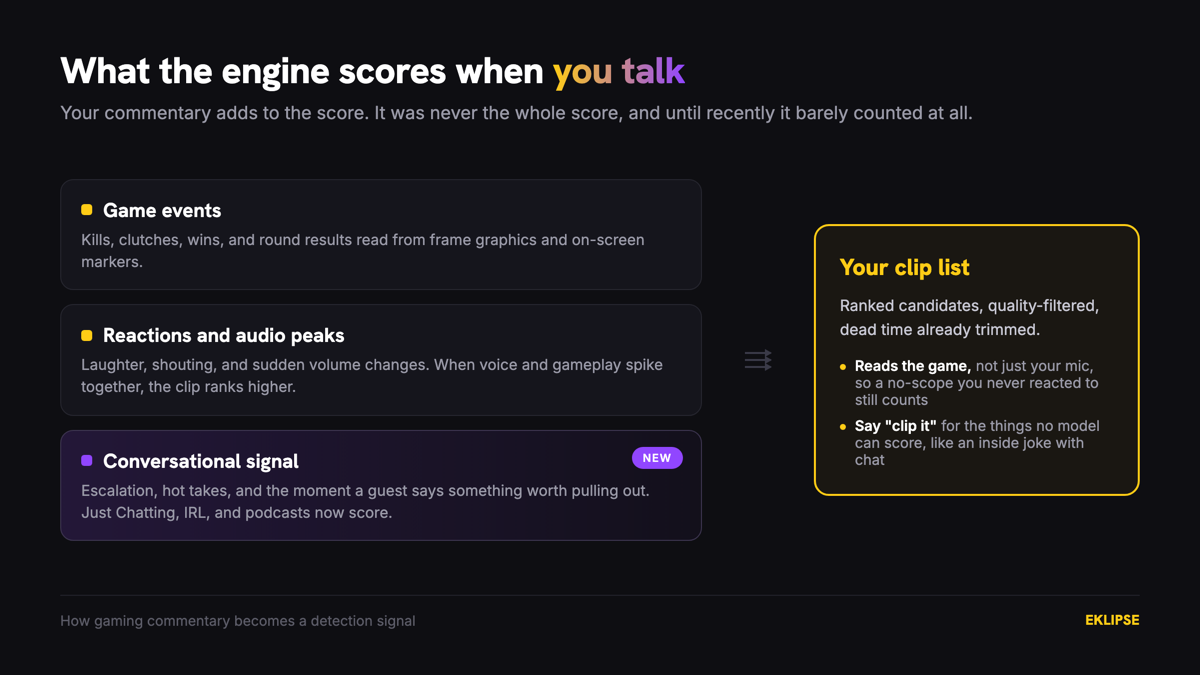
Reactions and audio peaks are scored alongside the gameplay signal rather than instead of it. Laughter, shouting, and sudden volume changes all count, and when your voice and the gameplay spike together the clip ranks higher.

There’s a deliberate design choice worth knowing here. Eklipse reads the game itself rather than only listening to your mic, which is why a no-scope you never reacted to still registers as a highlight. Your commentary adds to the score; it isn’t the whole score.

Three detection signals feeding a clip list: game events, reactions and audio peaks, and new conversational signal scoring
Conversational scoring is the newest of the three signals, and the reason talk segments now produce clips.

Ravi runs a variety channel that drifts between Rocket League and two hours of Just Chatting. For a year the second half of every stream produced nothing, because there was no kill feed to read. The footage wasn’t worse. It just wasn’t legible to a game-only model, and the clips he wanted most were the ones he had to find manually.

For anything sitting outside gameplay entirely, the Just Chatting use case covers what the engine looks for in talk-heavy segments.

Keep the commentary intact when the clip gets cut

Here’s the failure mode nobody warns you about.

Detection cuts around an event. Sentences don’t respect events. So the model hands you a clip that opens on the second half of “and if he pushes here I’m completely” and ends mid-word on the reaction.

Gameplay survives a rough cut. Speech doesn’t. A clip that starts on a partial sentence reads as broken in a way that a clip starting mid-firefight never does.

Timeline showing an event-based cut slicing a sentence in half versus a speech-boundary cut that keeps the full commentary
The event cut lands mid-sentence. The speech cut costs you one drag of a handle.

Three habits fix nearly all of it:

  • Move the in-point to the start of the sentence, not the start of the action. If the sentence begins 1.5 seconds before the model’s cut, take those 1.5 seconds. Speech boundaries beat event boundaries every time.
  • Let the sentence finish before you cut out. Trailing off mid-word is the single most common reason a clip feels amateur, and it costs one drag of a handle to fix.
  • Cut on breaths. The pause between sentences is a clean edit point that sounds intentional. Cutting inside a word never does.

This overlaps with a broader point about where clips should start, which we covered in why repurposed clips get no views. The short version: the model finds the moment, and you decide where it begins.

Captions are how commentary reaches a muted feed

A large share of short-form gets watched with the sound off. If your commentary lives only in the audio track, most of the feed never receives it.

Captions are how commentary gets delivered. AI-Edit transcribes the clip and times it word by word, then styles it in gaming-native fonts that move with the audio, which keeps the rhythm of how you said it rather than dumping a paragraph on screen.

Four things separate captions that work from captions that just exist:

  • Burn them in. Platform auto-captions are toggled off for many viewers and get stripped when a clip is downloaded and reposted.
  • Caption your voice, not the kill feed. The kill feed is already on screen. The commentary is the layer only you have.
  • Cut the filler from the transcript. Every “uh” and “like” that was invisible in speech becomes very visible as text. Trim them.
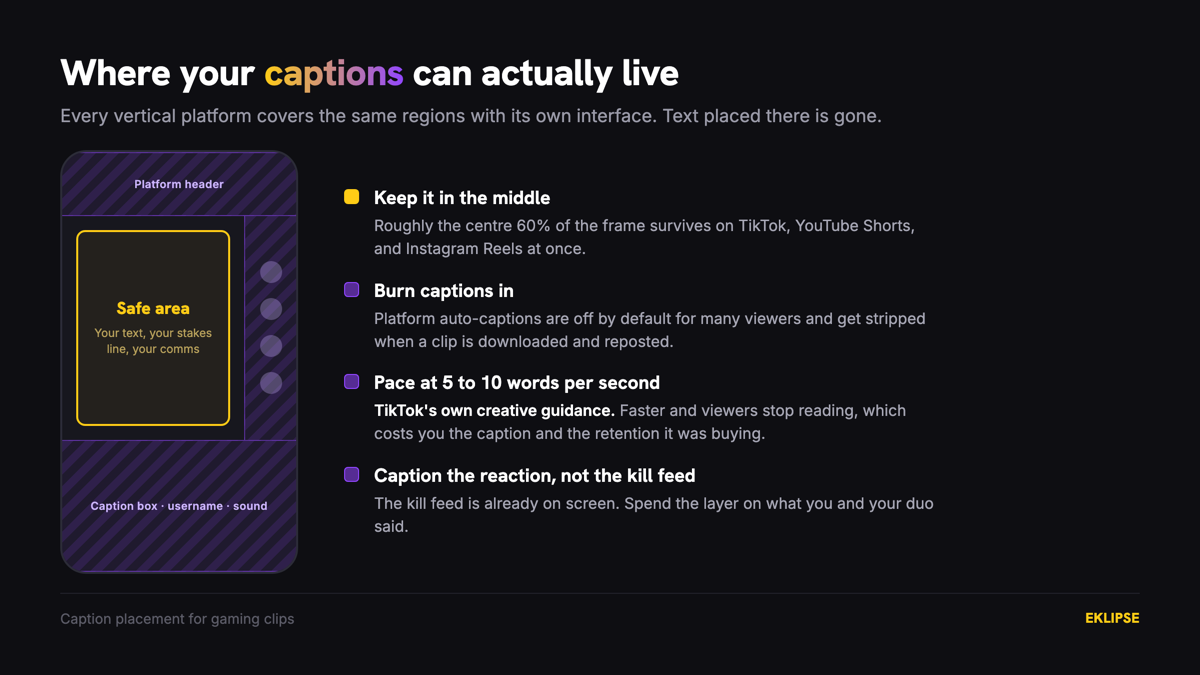
  • Keep text out of the bottom third. The platform caption box, username, and sound attribution sit there on every vertical app.

Word-by-word timing matters more than font choice here. A punchline that appears all at once has no timing, and timing is most of what made it funny.

Mixing game audio against your voice

Commentary that’s buried is the same as no commentary, and this is where most self-edited clips fall down.

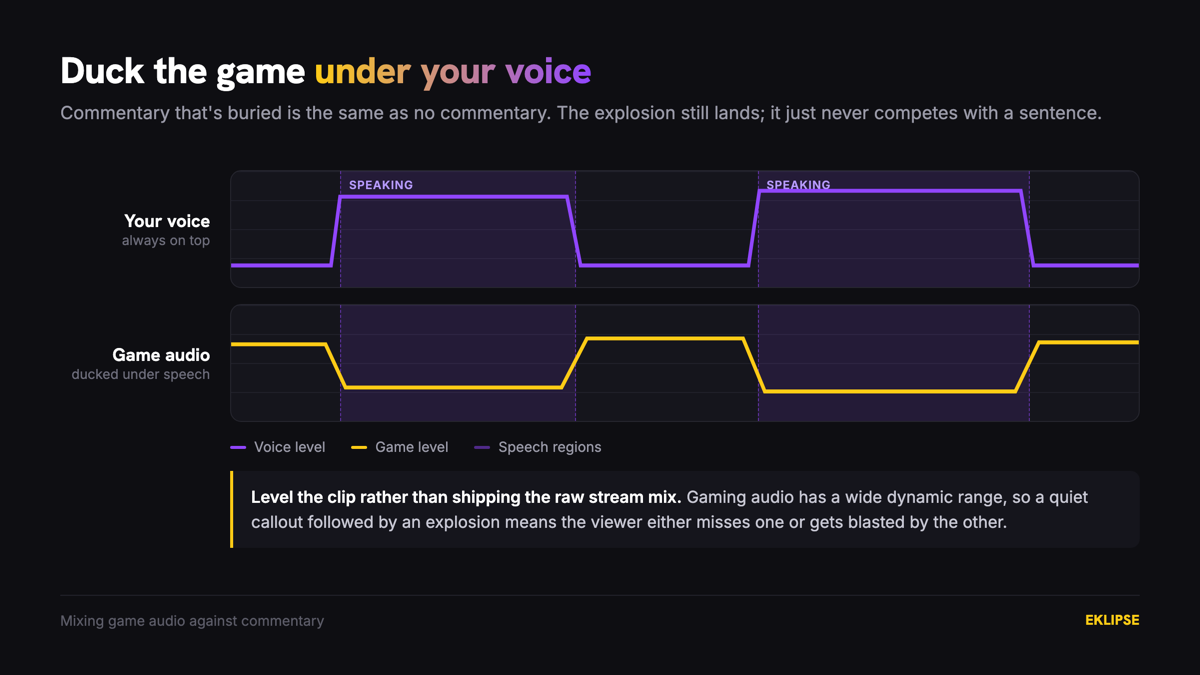
Your voice should sit clearly above the game. If a viewer has to work to catch a word, they scroll instead. Duck the game audio under speech and bring it back up in the gaps, so the explosion still lands but never competes with the sentence.

Two audio level lanes showing game audio ducking beneath speech regions so commentary stays clearly audible
Game audio drops while you speak and returns in the gaps.

One consequence worth flagging: transcription accuracy drops when background music runs louder than your voice. If you run music hot on stream, check the caption pass before posting rather than after, because a mistranscribed punchline is worse than no caption.

Gaming audio also has a wide dynamic range. A quiet callout followed by an explosion means the viewer either misses the callout or gets blasted, so level the clip rather than leaving the raw stream mix.

When you actually need to record new commentary

If the footage has no mic track, none of the above applies and you’re producing something new. Be clear-eyed about this: no AI tool writes or performs your commentary. Eklipse doesn’t generate voiceover, and neither does anything else worth using.

The workflow is manual and it’s not long:

  1. Pick the clip first and cut it to length before writing anything. Commentary written before the edit always runs long.
  2. Watch it once and note where you’d naturally speak. Silence in the right places is part of the performance.
  3. Write to the picture, not to a word count. Aim to finish a beat before the visual moves on.
  4. Record in one take if you can, because retakes flatten the delivery.
  5. Duck the game audio and align the take to the action.

Then run captions over the result exactly as you would for live commentary.

Elena records solo Elden Ring sessions with no mic and used to write full scripts before touching the edit. The narration kept overrunning the visuals, so she’d re-cut the footage to fit the words. Cutting the clip first and writing to it reversed the dependency, and the takes stopped needing a third pass.

What the AI won’t do for you

Worth stating plainly, because the marketing in this category is loose.

Detection finds moments and scores conversational signal. Transcription turns speech into text. Captions style and time that text. Every one of those is labor, and all of it is handled.

Nothing in that list is authorship. No model decides your angle, writes your joke, chooses your tone, or performs a take. It cannot tell you that a bit ran too long or that a story only lands for people who watch you regularly.

There’s also a genuine limit on detection itself. Conversational scoring picks up escalation and volume, which correlates with interesting but isn’t the same thing. A calm, quiet, genuinely insightful two minutes produces a weak signal, and you’ll still find those by hand. Say “clip it” in the moment and the timestamp is marked for you, which is the cheapest fix for anything a model can’t score.

Frequently asked questions

Can AI add commentary to my gaming videos automatically?

No. AI detects moments, transcribes speech, and generates captions, but it doesn’t write or perform commentary. If your footage has no voice track, recording one is a manual job.

How do I add commentary to gameplay I already recorded without a mic?

Cut the clip to final length first, watch it once to find your natural speaking points, write to the picture, then record a single take and duck the game audio underneath it. Writing before cutting is what makes narration overrun.

Does Eklipse clip Just Chatting and podcast segments?

Yes. Since the engine update, detection covers Just Chatting bits, IRL segments, and podcast moments alongside gameplay. Talk content is scored on conversational signal rather than game events.

Why does my clip start in the middle of a sentence?

Because detection cuts around the event, and events don’t line up with speech. Drag the in-point back to where the sentence starts, which is usually one to two seconds earlier.

Do I need captions if my commentary is good?

Especially then. Most short-form is watched muted, so uncaptioned commentary reaches a fraction of the people who see the clip.

Should the game audio or my voice be louder?

Your voice, consistently. Duck the game under speech and let it come back up in the gaps so effects still land without burying a word.

Start with the commentary you already have

Gaming commentary is a preservation problem far more often than a production problem. If you streamed, the reactions are in the footage, in sync, and genuine, and the engine now scores them instead of ignoring them.

The work that’s left is small and specific. Move the in-point to the start of the sentence, let it finish before cutting out, burn in word-by-word captions, and keep your voice above the game.

Save the recording booth for footage that genuinely has no voice on it.

If you want the moments where you said something worth keeping already pulled out of your last stream, connect your Twitch or Kick account and start clipping.

AI video editing: what it replaces and what it can’t

0
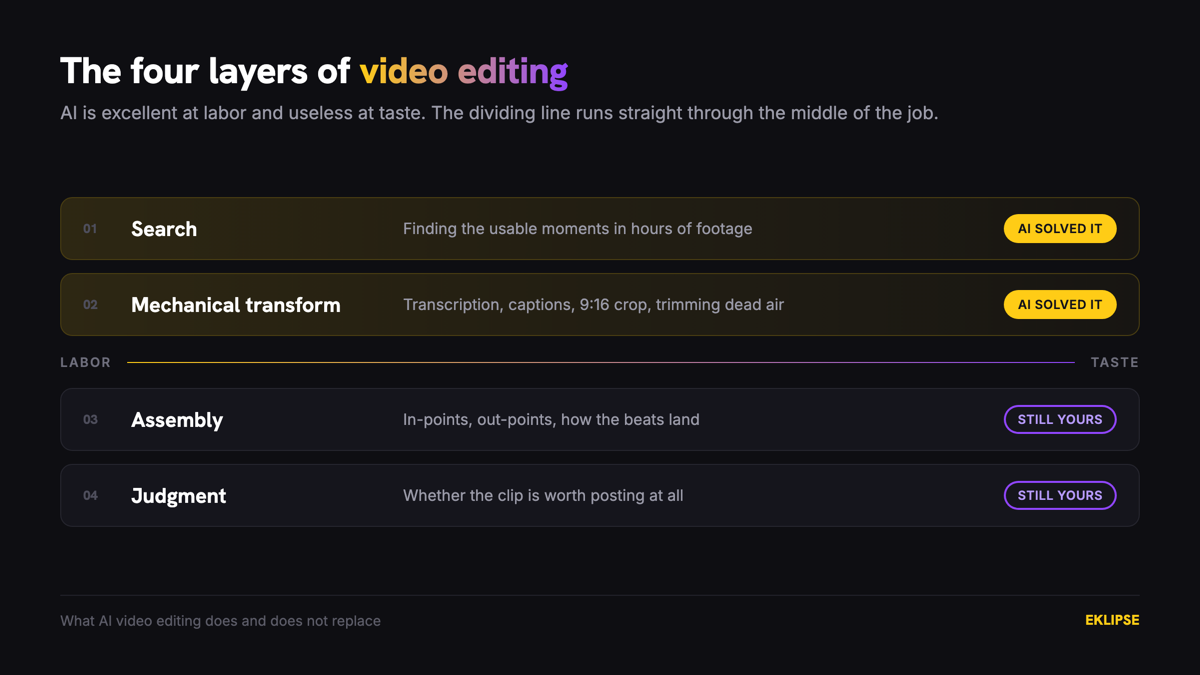
Stack of the four video editing layers showing AI has solved search and mechanical transform while assembly and judgment remain manual
The four layers of video editing

AI video editing: what it replaces and what it can’t

AI video editing removes two of the four layers of editing work and barely touches the other two. It eliminates the search for usable moments and it makes transcription, captions, and reformatting close to free. It does not decide where a clip should start, and it has no opinion on whether a clip is worth posting.

That split is the whole story, and almost nobody sells it honestly.

Every tool page you’ve read promises to “edit your videos with AI” as though editing were one job. It’s four, and knowing which two you still own is the difference between shipping 15 good clips a week and shipping 15 forgettable ones.

This guide breaks down each layer, what AI does to it, and where the work moves next.

Key takeaways

  • →Editing splits into search, mechanical transform, assembly, and judgment; AI has effectively solved the first two.
  • →The gain is throughput, not quality — nothing about the model makes any individual clip better than a good editor would.
  • →Twitch now ships Auto Clips, captions, and a voice command natively, so the mechanical layer is becoming table stakes, not a differentiator.
  • →Detection is genre-dependent: it works on games with discrete events and degrades on strategy and narrative content.
  • →The bottleneck moved from labor to taste, and most creators haven’t noticed because the old bottleneck was so loud.

The four layers of video editing, and which two AI removes

Before AI, a creator turning a stream into short-form did four distinct jobs, usually without naming them.

Search meant scrubbing hours of footage to find the moments worth keeping. Mechanical transform meant transcription, captions, cropping to vertical, trimming silence, and levelling audio. Assembly meant choosing in-points and out-points and deciding how the beats land. Judgment meant knowing which clips deserved a post.

Search and mechanical transform are labor. Assembly and judgment are taste. AI turned out to be excellent at labor and useless at taste. The whole creator-tools market is still working out what that means.

Stack of the four video editing layers showing AI has solved search and mechanical transform while assembly and judgment remain manual
AI’s reach stops exactly where labor ends and taste begins.

Here’s the split as it stands:

Layer What AI does to it What’s left for you
Search Effectively eliminated Nothing
Mechanical transform Effectively solved, near-zero cost per clip Spot-checking accuracy
Assembly Barely touched; models cut around events, not tension All of it
Judgment Not touched at all All of it

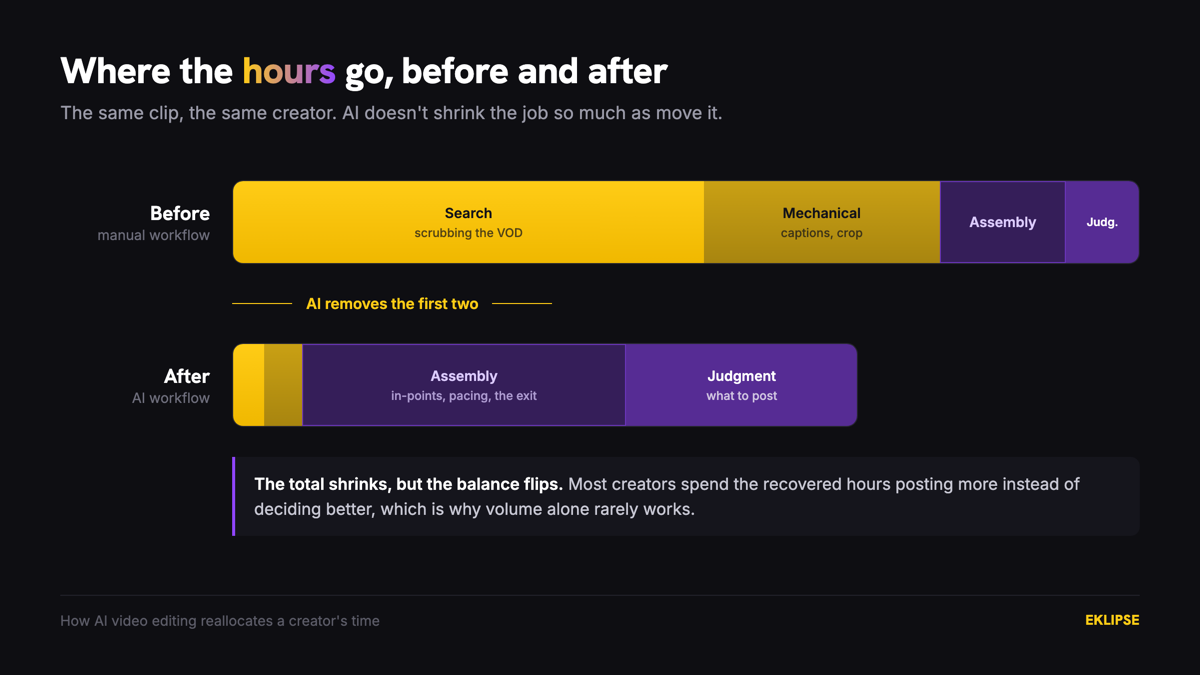
Read that table as a budget. The hours you used to spend on the top two rows are now available for the bottom two, and most creators spend them posting more instead.

Before and after bars showing editing time shifting from search and mechanical work toward assembly and judgment
The total shrinks, but the balance flips toward the two layers you still own.

Layer one: AI video editing kills the search step

This is the large win and it’s genuinely large. Finding the usable 90 seconds inside a six-hour VOD was the single most expensive thing about being a streamer who also posts.

Detection models watch the whole recording for signals a human would have to sit through: kill feed entries, audio spikes, chat bursts, on-screen events. Automatic highlight detection scans a multi-hour VOD in roughly 15 to 20 minutes and returns a shortlist you review instead of a timeline you scrub.

The economics are stark. Manual search scales linearly with footage length, so a creator who streams more has strictly less time to post. Automated search is close to flat, which breaks that constraint entirely.

Sam streams around 20 hours a week and used to post twice. The posting rate wasn’t a discipline problem. Reviewing 20 hours to find six clips took longer than the streaming did, so most weeks the footage sat untouched until it felt stale enough to skip. Search was the only reason his output was two.

Layer two: the mechanical work is now near-free

Transcription is solved. Captions generated from that transcription are solved. Cropping 16:9 gameplay to 9:16 with subject tracking is solved. Trimming dead air and levelling audio are solved.

None of these were hard problems intellectually. They were just slow, and slow is exactly what machines fix. A caption pass that cost 20 minutes per clip now costs nothing per clip, which changes what you’re willing to make. Tools like Eklipse Studio bundle the whole layer into one pass over the shortlist.

Two things still need your eyes. Caption accuracy drops when background music runs louder than your voice, so check the transcript before you post rather than after. And auto-crop follows the wrong subject on split-attention footage, like a facecam reacting to something happening at the edge of frame.

Worth knowing: the mechanical layer is where nearly all “AI video editor” marketing lives. If a tool’s pitch is captions and cropping, you’re looking at a commodity, and the next section explains why that matters.

Layer three: assembly is where AI still guesses wrong

Here’s where the honest version diverges from the sales pitch.

Detection models are trained on discrete events, so they cut a window centered on the moment something happened. Short-form retention gets decided before that moment. YouTube reports “Viewed (vs swiped away)” for Shorts precisely because the stay-or-scroll decision lands in the opening frames, and TikTok’s creative guidance puts 90% of recall impact inside the first six seconds.

So the model hands you a clip that opens on a clutch resolving, when the thing that would have held the viewer is the four seconds before it, where three teammates died and you were left on 14 HP. There’s no kill feed entry for “the situation just got hard.” A model tuned on events cannot see the absence of one.

This is a structural limit, not a maturity problem. It’s also the highest-value work left on your plate, and we covered the fix in why repurposed clips get no views.

Layer four: judgment doesn’t transfer

No model knows whether your clip is funny. It knows whether your audio spiked.

Those two things overlap enough to find moments. They don’t overlap enough to pick between them. A model can tell you 15 things happened. It cannot tell you that four of them are the same joke, that one only lands for regulars, and that two are mechanically impressive but unreadable to anyone who doesn’t play the game.

This is why throughput without judgment makes accounts worse rather than better. Posting everything the model returns trains the recommendation system on your weakest output, and the weak posts drag the reach of the strong ones.

Nadia had the opposite problem from Sam. Her tool was returning around 12 clips a session and she was posting all 12, on the theory that volume was the point. Cutting to three per session and spending the recovered time on in-points meant the account posted a quarter as much, and every post had a reason to exist. The AI hadn’t gotten worse. She’d started doing the layer it was never doing.

Why AI video editing gains are commoditizing

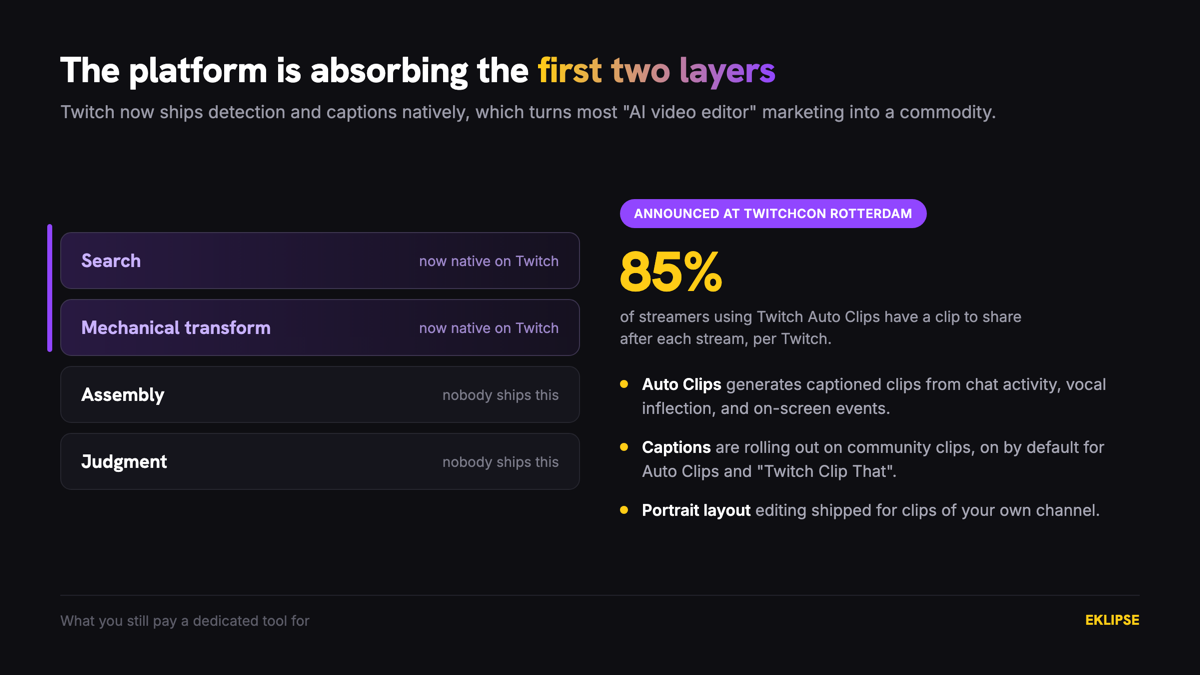
If your tool’s advantage is layers one and two, that advantage has a short shelf life, because the platforms are absorbing both.

At TwitchCon Rotterdam, Twitch announced Auto Clips, which generates captioned clips from stream moments using chat activity, vocal inflection, and on-screen events. Twitch reports that 85% of streamers using it have a clip to share after each stream. Captions are rolling out on community clips with editable text, timing, and style, and they’re on by default for Auto Clips and the “Twitch Clip That” voice command. Portrait layout editing shipped too.

Read that list against the four layers. Twitch is absorbing exactly layers one and two, natively and free, for anyone streaming on Twitch.

Diagram showing Twitch Auto Clips and native captions covering the search and mechanical layers of AI video editing
Anything sold as captions-and-crop is turning into a platform feature.

That’s not a reason to stop using dedicated tools. It’s a reason to be precise about what you’re paying for: multi-platform output, detection across a full VOD rather than a live session, deeper editing passes, and control over the assembly layer. Anything sold as captions-and-crop is about to be a platform feature.

Where AI video editing quietly fails: genre dependence

Detection accuracy varies more by game genre than any vendor admits. The pattern is predictable once you know what the model reads.

Event-based models perform well on FPS and battle royale titles, where kills, downs, and victories fire discrete, machine-readable signals. Accuracy degrades on strategy games, management sims, and narrative content, where tension builds over minutes and produces nothing that looks like a spike.

Talk-heavy content sits between the two. Newer detection covers Just Chatting, IRL, and podcast segments by reading emotional peaks and escalation rather than combat events, which puts a category back on the table that used to be written off entirely.

Content type Signal the model reads What to expect
FPS and battle royale Kill feed, downs, win screens Strong. Spend your time on assembly
Sports and racing titles Score changes, finish events Strong on outcomes, weak on near-misses
Just Chatting, IRL, podcast Vocal escalation, chat bursts, reaction peaks Workable. Review more of the shortlist
MOBA and MMO Kills and objectives, but slow context Mixed. Teamfights land, macro plays don’t
Strategy, management, narrative Almost nothing discrete Weak. Budget for manual search

The practical rule: if your game produces a visible kill feed or a win screen, expect strong detection and spend your time on assembly. If it doesn’t, expect to do more of the search yourself and budget accordingly.

Frequently asked questions

Can AI edit videos completely on its own?

No. AI reliably handles finding moments, transcribing, captioning, cropping to vertical, and trimming dead air. It does not choose where a clip should start, judge whether a moment is worth posting, or structure a sequence, and those are the parts that determine whether the clip performs.

Does AI video editing actually save time?

Yes, substantially, and it changes what the time is spent on. Manual search scales with footage length while automated search is close to flat, so a six-hour VOD costs about the same as a two-hour one. The hours recovered are best spent on in-points and curation rather than on posting more.

Is AI video editing good enough to replace a human editor?

For clip extraction and formatting, yes. For anything requiring narrative structure, comedic timing, or taste, no. Most creators don’t need an editor for the first category and can’t get the second from a tool at any price.

Why does the AI pick clips that aren’t interesting?

Because it’s detecting events, not evaluating them. An audio spike registers identically whether you were laughing or your dog knocked over a lamp. Treat the output as a shortlist to curate rather than a set of finished clips.

Will Twitch’s built-in tools make AI editors unnecessary?

For basic captioned clips from a live Twitch session, largely yes. Dedicated tools stay useful for full-VOD detection, multi-platform formatting, deeper editing control, and creators streaming on Kick or YouTube where Twitch’s features don’t apply.

What to do with the time AI gives back

AI video editing is a labor solution wearing a quality costume. It removes the search step and makes the mechanical work close to free. For anyone who streams more hours than they can review, that changes everything.

What it does not do is decide anything. Assembly and judgment stayed exactly where they were, and they’re now the only two layers where one creator can beat another.

So the practical move is unglamorous. Let the detection produce the shortlist, spend the recovered hours dragging in-points earlier and cutting the clips a stranger couldn’t follow, and stop treating output volume as the score.

If you want the shortlist waiting after your next session so the time goes into the edit instead of the search, connect your Twitch or Kick account and start clipping.

Viral gaming clips: why repurposed clips get no views

0

Viral gaming clips: why repurposed clips get no views

To make repurposed clips engaging, edit the two seconds before the play and the two seconds after it. AI highlight detection cuts around the peak of a moment, so the raw clip opens on an outcome the viewer has no reason to care about yet, and they swipe before the play lands.

Your clip is not losing because the play was bad. It’s losing because nobody found out what was at stake.

You already know this on some level. You’ve posted a 1v4 that you were proud of, watched it die at 340 views, and then watched a worse play from a smaller account pull 90,000. The footage was never the variable. The packaging was.

This guide covers what to change after the clips already exist: the opening frames, the captions, the context layer for non-players, the exit, and which clips from the batch deserve a post at all. It assumes you have already solved extraction. If you haven’t, start with automatic highlight detection and come back.


Key takeaways
– AI highlight detection timestamps the peak of a play, not the setup that makes the peak readable, which is why raw auto-clips underperform
– YouTube Studio reports “Viewed (vs swiped away)” for Shorts, and that decision happens in the opening frames, before your clutch resolves
– TikTok’s own creative guidance says 90% of recall impact lands in the first six seconds and recommends 5โ€“10 words per second of on-screen text
– Most of your feed does not play your game, so the clip has to state the stakes visually rather than assume game knowledge
– Posting all 15 clips from a VOD trains the algorithm on your worst ones; post 3 and cut the rest


Two reasons your gaming clips get no views

There are exactly two failure modes, and the fix for one does nothing for the other. Diagnose before you edit.

Extraction failure means the clip contains the wrong footage. The AI grabbed a kill that was mechanically boring, or it cut a funny moment two seconds after the punchline. You’ll recognize this because when you rewatch the clip, you also feel nothing.

Packaging failure means the footage is genuinely good and the clip still dies. You rewatch it and think “this is a great play,” but the retention graph flatlines in the first second. This is the common case for streamers using auto-clipping, and it’s the one this article fixes.

Here is the test. Send the clip to someone who does not play your game and ask them to describe what happened. If they can’t, you have a packaging failure, regardless of how good the play was.

Most creators diagnose this wrong. They assume low views mean the AI picked badly, so they go back to scrubbing VODs manually, which costs hours and produces the same result. The AI picked fine. The clip’s just starting in the wrong place.

Want to see the footage on either side of what the detection handed you? Eklipse Studio shows the full clip with handles on either side of the detected moment, which is where the fixes below get applied.

The setup gap: why AI-cut clips start too late

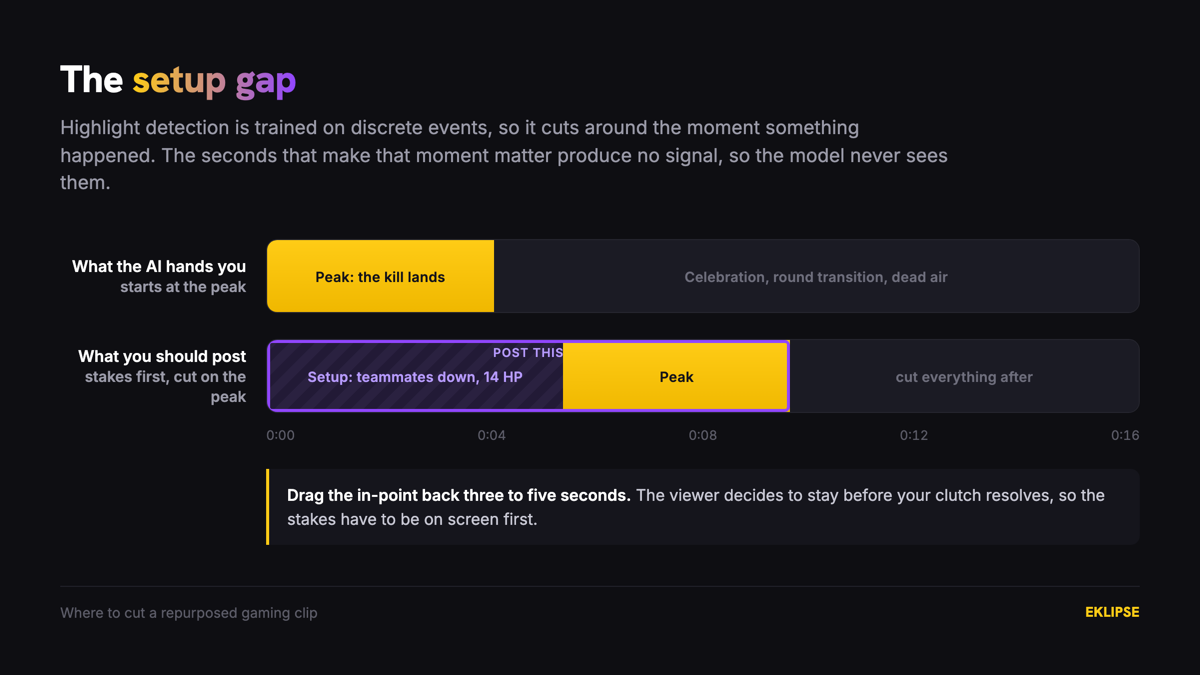
Highlight detection models are trained on discrete events. A kill feed entry, an audio spike, a chat burst. The model finds the event and cuts a window around it, and that window is centered on the moment the event happened.

Short-form retention is decided before that. YouTube documents two Shorts metrics in Studio: “Shown in feed,” meaning how many times the Short surfaced, and “Viewed (vs swiped away)”, the percentage of those surfaces where the viewer stayed instead of scrolling. TikTok’s creative best practices put the same idea in numbers: 90% of recall impact is captured within the first six seconds.

So the swipe decision happens in a window that your clip spends showing an outcome with no stakes attached. The clutch resolves at 0:04. The viewer left at 0:01.

This is the gap. The AI found the peak. It didn’t find the setup, because the setup isn’t an event, it’s an absence of one. There is no kill feed entry for “three teammates just died and Marcus is alone in a building with 14 HP.” A model tuned on discrete events cannot see that, and it’s the only reason the peak means anything.

Which is why the single most valuable edit on any repurposed clip is dragging the in-point earlier.

Timeline comparing an AI-cut gaming clip that starts at the peak against a clip that opens on the setup and cuts on the peak
The AI cut starts where the event fired. The postable clip starts where the situation got hard.

Marcus, a Valorant streamer, had a 1v4 retake sitting at 200 views. The auto-clip opened on him already peeking, first kill landing half a second in. He pulled the in-point back four seconds and now the clip opens on his last teammate going down and the spike already planted, with the round timer visible in the corner. Same play, same footage, one drag of a handle. The viewer who lands on it now has a reason to wait: they want to know if he makes it.

Rebuild the first two seconds of every gaming clip

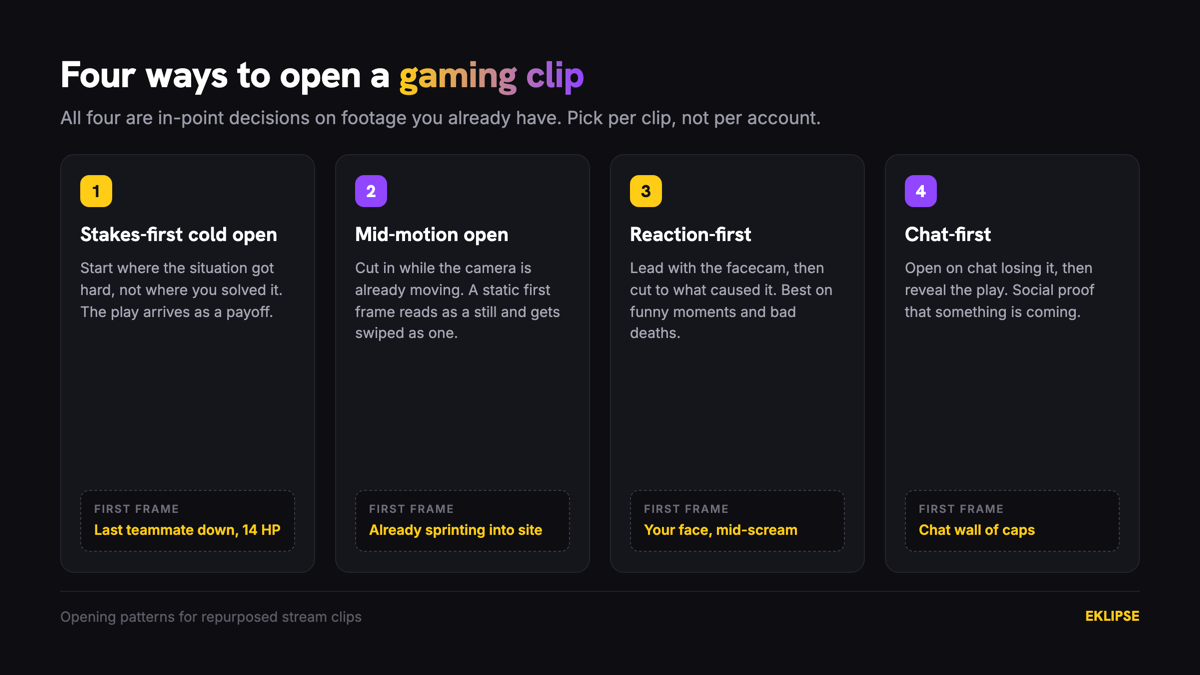
Once you know the in-point is the problem, there are four patterns that work on gameplay footage. Pick per clip. Don’t apply the same one to every post, because a feed of identical openings reads as a template.

Four opening patterns for repurposed stream clips: stakes-first cold open, mid-motion, reaction-first, and chat-first
Four opening patterns, and what the first frame shows in each.

Stakes-first cold open. Start on the moment the situation becomes hard, not the moment you solve it. Last teammate down, low HP, final zone closing, one bullet left. The play then arrives as a payoff instead of a fact.

Mid-motion open. Cut in while the camera is already moving. A static opening frame reads as a still image for the first beat and gets swiped as one. Movement holds the eye long enough for the caption to land.

Reaction-first. Lead with your facecam reaction, then cut to the gameplay that caused it. This works well on funny moments and terrible deaths, where the emotion is the content and the mechanics are secondary.

Chat-first. Open on the chat losing it, then reveal the play. Chat reacting is social proof that something is about to be worth watching, and it works even for viewers who have never been in your stream.

None of these need a new recording. They’re all in-point decisions on footage you already have.

Captions are the cheapest fix for gaming clip retention

A large share of short-form gets watched with sound off, and gameplay audio is the part people mute first. Captions are not an accessibility afterthought on gaming clips, they are the layer carrying your comms, your reaction, and the joke.

Vertical clip frame showing platform interface regions and the centre safe area where burned-in captions stay visible
TikTok, Shorts, and Reels all cover the same regions. Roughly the centre 60% survives on all three.

Four rules that matter more than caption style:

  • Burn them in. Platform auto-captions are toggled off by default for many viewers and get stripped when a clip is downloaded and reposted. If the caption is not in the pixels, assume it isn’t there.
  • Keep the pacing readable. TikTok’s guidance recommends 5โ€“10 words per second for on-screen text. Faster than that and viewers stop reading entirely, which loses you the caption and the retention it was buying.
  • Stay out of the platform UI. The bottom third of a vertical clip is covered by the caption box, username, and sound attribution on every platform. Anything you place there is gone.
  • Caption the reaction, not the kill feed. The kill feed is already on screen. Transcribing it wastes the one layer you have. Caption what you said, what your duo said, and what was going through your head.

The twitch clip captions and kick captions queries both sit on page 1 of Google for Eklipse, which tells you how many streamers hit this wall. Eklipse ships auto-caption styles as part of the clip output, so the transcription step is handled and your job is the editorial one: deciding what to cut from the transcript so the screen is not a wall of text.

One caution. Auto-caption accuracy drops when background music is louder than your voice. If you run music hot on stream, check the caption pass before you post rather than after.

Make the play legible to people who don’t play your game

The FYP does not filter by game. Most people who see your Valorant clip have never loaded Valorant, and they are the reason a clip breaks out past your existing audience.

This is where repurposed clips fail hardest, because you edited them as a player. You know a Chamber TP out of a lost site is impressive. The viewer sees a man teleport for no stated reason.

The fix is one line of on-screen text placed in the opening two seconds, stating the constraint in plain English. Not “1v4 retake.” That’s jargon. “Everyone else is dead. He has 14 HP.” That’s a stake anyone can hold.

Priya streams Marvel Rivals to a few hundred concurrents and had been captioning her clips with the ultimate’s name. She swapped one clip’s opening text from “Luna Snow ult” to “if I miss this, we lose the round.” The gameplay was untouched. The difference is that the second version tells a non-player what to watch for, so there is a question open while the play runs.

Three things carry legibility on gameplay footage without needing text: a visible health bar at a dangerous number, a visible timer near zero, and a visible score that is close. If your clip has none of those on screen, the text line is doing all the work and it had better be good.

For game-specific packaging, the Valorant highlight clipper page covers which moments in tactical shooters read to outsiders and which ones only land for players.

Cut the clip before the celebration

Every streamer over-runs the ending. The ace lands, and then there are six seconds of you yelling, your duo yelling, and the round transition screen.

Cut on the peak or half a beat after. Dead air at the end of a short-form clip is what kills loops, and loops are the cheapest retention multiplier available, because a clip that loops cleanly counts a second view without earning a second impression.

Two practical cuts:

  • End on the last meaningful frame. The kill, the reaction face, the chat exploding. Whichever is last, end there and not on the thing after it.
  • Match the ending to the opening. If you opened mid-motion, end mid-motion. The loop becomes invisible and viewers watch two or three times without noticing.

Length follows from this rather than from a target. If the setup needs four seconds to establish stakes and the play takes six, the clip is ten seconds. Don’t pad it to hit a number, and don’t compress the setup to hit one either.

What separates a viral gaming clip from one that just looks good

A VOD run gives you 10 to 20 clips. Posting all of them is the most common mistake in this workflow, and it’s worse than posting nothing, because the weak ones teach the recommendation system what your account is.

Curate to three per session using two questions:

  1. Can a non-player tell what happened without you explaining it?
  2. Is there a question open in the first two seconds that the clip answers?

A clip that fails both is a clip for your Discord, not for TikTok. Send it to the people who already care.

Deni runs a Kick channel and was posting every clip Eklipse returned, roughly 12 a day. He cut to three, spent the recovered time rebuilding in-points and writing one opening text line per clip, and stopped posting the mechanically clean kills that had no story attached. The account posts a quarter as much and every post now has a reason to exist.

Be honest about what does not repurpose. Strategy games and long-setup moments resist short-form because the tension builds over minutes and cannot be compressed into a hook. Inside jokes with your regulars land in your community and nowhere else. Eklipse’s newer detection covers Just Chatting, IRL, and podcast-style segments, so those are back on the table, but a 40-minute macro decision in a 4X game is not becoming a good Short no matter how you cut it.

Once the packaging is consistent, scheduling is the remaining bottleneck, and the content planner handles the posting cadence so the edit is the only thing you are spending attention on.

Frequently asked questions

Why do my Twitch clips get no views on TikTok?

Almost always because the clip starts at the moment the play resolves instead of the moment it became difficult. TikTok viewers decide within the first few seconds, and a clip that opens on an outcome gives them nothing to stay for. Drag the in-point back three to five seconds so the stakes are visible before the payoff.

How long should a gaming clip be for TikTok and YouTube Shorts?

Long enough to establish stakes and deliver the play, which is usually 8 to 20 seconds for a single moment. Don’t pad to reach 60 seconds for monetization thresholds, because completion rate matters more than duration on both platforms.

Do I need captions on gaming clips?

Yes, and burned in rather than platform-generated. A large share of short-form is watched muted, and gaming audio is the first thing viewers turn off. Caption your voice and your comms, skip the kill feed, and keep text out of the bottom third where the platform UI sits.

Why does the AI pick clips that aren’t interesting?

Detection models find discrete events like kills, audio spikes, and chat bursts. They can’t see the setup that made the event matter, because an absence of action produces no signal. The model’s doing its job by flagging where something happened, and the setup is the part you add back in the edit.

How many clips should I post per stream?

Three from a typical session, chosen for whether a non-player can follow them. Posting all 10 to 20 dilutes your account signal, and the weak posts drag the reach of the strong ones.

Does this apply to Kick and YouTube VODs too?

Yes. The setup gap is a property of event-based detection, not of a platform. Kick and YouTube VODs come back with the same peak-centered cuts, and the same in-point fix applies.

Start with the clips you already have

Viral gaming clips aren’t a footage problem for anyone who already streams. You have the moments. Five edits separate a clip that travels from one that dies inside your own audience, and none of them require new gameplay.

Work in this order on your next batch: drag the in-point back until the stakes are visible, write one plain-English line of opening text, burn in captions for your voice, cut the ending on the peak, and post only the clips a stranger could follow.

The extraction is already solved. Detection scans a multi-hour VOD and hands you the shortlist, which frees the time this edit needs. If you want that shortlist waiting for you after your next session, connect your Twitch or Kick account and start clipping.

How to become a clipper in 2026 (and actually get paid)

0

To become a clipper, you cut long streams into short vertical clips and post them where they earn: either your own streams through a rewards program, or other creators’ streams on a clip channel. The fastest path in 2026 is an AI clip maker that finds and cuts the moments for you, so you can post at the volume that actually pays.

You already know the problem. A good stream or a good VOD is three hours long, and almost nobody watches three hours. The 40 seconds that would pop on TikTok are buried somewhere in the middle, and finding them by hand is the reason most people quit before their first payout.

This guide breaks down what the job involves, the two ways clippers get paid, the exact workflow to start this week, and where the money comes from. No “go viral” fluff. Just the parts that move a number.

> Key Takeaways
> – A clipper turns long-form gameplay or streams into 15 to 60 second vertical clips for TikTok, YouTube Shorts, and Reels. You don’t need to show your face or make original content.
> – There are two pay paths: post clips of your own streams into a rewards program, or build a clip channel around other creators and earn from platform ad revenue or streamer deals.
> – Volume decides everything. Consistent clippers hit $1,000 to $2,000 a month within about 90 days; occasional posters earn close to nothing.
> – An AI clip maker like Eklipse’s AI highlights removes the bottleneck by scanning your VOD and cutting the top moments automatically, so you can post daily instead of weekly.
> – Eklipse’s Creator Rewards program is a live, free-to-enter example: in June 2026, 1,950 creators stacked 7.85M accumulated views and 14 walked away with cash and games.

What a clipper does (and what you don’t need to start)

A clipper takes long content, a livestream, a VOD, a podcast, or a YouTube video, and cuts it into short vertical clips built for TikTok, Reels, YouTube Shorts, and X. You are not the streamer. You don’t play the game on camera, and you don’t need editing experience to start.

The job has two halves. First, find the moment worth watching: the clutch, the multi-kill, the on-stream meltdown, the line that made chat lose it. Second, format it so the first three seconds hook a scroller and the rest keeps them.

That second half is where the platforms reward you. Vertical clips get pushed harder in the feed than reposted widescreen footage, which is why “just crop it” clippers get buried and clippers who caption and reframe get reach.

Here is the split most beginners miss. You can clip your own streams, or you can clip other people’s streams. They pay differently, they carry different rules, and the tool you need is the same for both. We’ll cover both paths below.

Want to see the cutting step done automatically before you commit a weekend to it? See how AI highlights work and come back.

How to become a clipper in 2026: the workflow

You can start this week with a phone and one tool. Here is the order that gets you to a first payout fastest.

Step 1: Pick one lane

Own a niche instead of clipping everything. Gaming is the highest-volume lane for clip content, and inside gaming you pick a flavor: FPS highlight reels (Warzone, Valorant, Apex), a specific streamer’s funniest moments, or a single game’s community (Fortnite, Marvel Rivals, Roblox).

One lane trains the algorithm and trains you. You learn what that audience clicks, and your account stops looking random to the feed.

Step 2: Set up public posting accounts

Make public accounts on TikTok, YouTube Shorts, Reels, and X. Use the same handle everywhere so a clip that pops on one platform sends people to the others. Keep the bio simple and name the lane (“daily Warzone clips,” not “content creator”).

Step 3: Get the source footage

For your own streams, this is your VOD. For other creators, you pull public VODs (Twitch, Kick, YouTube), and this is where the rules matter: many streamers require credit or permission, and some run their own paid clip programs you should join instead of freelancing around them.

Step 4: Cut the clip (the part that used to take hours)

This is the whole bottleneck. Scrubbing a full VOD by hand to find three good seconds is why most clippers post once and stop. In 2026 you don’t do this manually. You paste the stream link into an AI clip maker, and it finds the kills, clutches, and reaction spikes for you.

Eklipse’s AI highlights is trained on 1,000+ game titles and reads on-screen markers like the kill feed to catch Multi-Kills, Clutches, and Victory Royales, then hands you the cuts. What took a morning takes a few minutes.

Step 5: Reframe, caption, and post

Convert the clip to 9:16, add captions (most short-form is watched on mute), and post. Tools like Eklipse Studio do the vertical crop and auto-captions in one pass, so you’re not re-editing every clip by hand.

Step 6: Post daily and keep score

Post at least once a day, ideally two or three times, at consistent times. Track which clips over-perform and make more of those. A content planner that schedules and auto-posts keeps you consistent on the days you can’t sit down and upload manually.

The two ways clippers get paid

This is the decision that shapes everything else. Read both, pick one to start, and add the second later.

Path A: your own streamsPath B: clip channel
Source footageYour own VODsOther creators’ public VODs
Who gets paidYou, directlyYou, minus platform and rules
Permission neededNone (it’s your footage)Often yes (credit or official program)
How it paysRewards program by accumulated viewsPlatform ad revenue plus streamer deals
Best forStreamers, even small onesNon-streamers building faceless channels
Start withEklipse Creator RewardsAn official streamer clip program

If you already stream, even to a small audience, you are sitting on source footage nobody else has. The move is to clip your own VODs, post them, and enter a creator rewards program that pays based on the views your clips stack up.

This path is the lowest-friction because there are no permission questions and no other creator taking a cut. You own the footage, you post it, the views count for you. Eklipse’s Creator Rewards program (covered in detail below) is built exactly for this: post clips from Eklipse, stack accumulated views, and top creators win cash and prizes.

Path B: build a clip channel around other creators

The classic “cash cow” model: pick a popular streamer or game, run a channel of their best moments, and earn from the platform’s own creator fund plus, sometimes, a direct deal with the streamer. Both major platforms pay short-form creators directly through the TikTok Creator Rewards Program and the YouTube Partner Program, so a channel that posts consistently can monetize on views alone.

The upside is scale. The catch is competition and rules. Many streamers run official clip programs (Kick’s clipping program is the biggest right now), and joining the official program usually beats freelancing, because you get credited, you avoid takedowns, and some pay per view directly. If you’re going the Kick route, start with how to become a Kick clipper with Eklipse and the Kick clips tool.

Which path pays more?

Neither is “better,” but they suit different people:

  • You already stream: start with Path A. Your own footage plus a rewards program is the shortest line to a payout, and you’re clipping content only you have.
  • You don’t stream and don’t want to: start with Path B. Pick one streamer or game, join their official clip program if they have one, and build a faceless channel.
  • You want the ceiling: run both. Clip your own streams for rewards, and run a faceless channel for ad revenue. Same tool, two income lines.

For a wider look at where the money comes from, Eklipse’s guide to the best platforms for monetizing gaming content maps the payout options by platform.

Why volume is the whole game

Here is the uncomfortable truth every clipper learns eventually: this is a volume business. One brilliant clip a week loses to ten decent clips a week, every time. The feed rewards frequency, and frequency is what separates the clippers earning $1,000 to $2,000 a month from the ones stuck at zero.

Realistically, consistent clippers hit that $1,000 to $2,000 range within about 90 days. The ones who post occasionally, no matter how talented, almost never get there. The single biggest predictor of a clipper’s income is not skill. It’s how many good clips they ship per week.

That’s exactly why the cutting step matters so much. If finding and cutting moments takes you an hour per clip, you physically cannot post at the volume that pays. If an AI does the finding and cutting, you can turn one three-hour stream into a month of daily posts.

The math is simple. Three hours of streaming, run through an AI clip maker, becomes 30 days of posted content, and those posts are the views that count toward a rewards payout or a channel’s ad revenue. That is the whole advantage: not working harder per clip, but removing the step that caps your volume.

> Ready to test the difference? Auto-clip your last stream with Eklipse and see how many postable clips one VOD produces.

Eklipse Creator Rewards: get paid to post your own clips

If you stream, the most direct on-ramp to getting paid as a clipper is the Eklipse Creator Rewards program. It pays creators for making clips, and it’s free to enter.

The mechanics are straightforward. You post clips directly from Eklipse to your socials, every eligible clip counts toward your total accumulated views, and your tier is set by how many views you stack during the program period. Top creators in each tier get rewarded. The AI does the clipping through Eklipse’s Content Agent, which scans your full VOD after every stream, pulls your top three moments, reframes them to 9:16 with captions, and auto-posts to TikTok and Shorts.

The current edition runs July 1 to 31, 2026, with three tiers:

  • Bronze (10K+ accumulated views): top 3 creators each win 1 month of Premium
  • Silver (40K+ accumulated views): top 4 creators each win a game copy plus $50 cash
  • Gold (70K+ accumulated views): top 3 creators each win a top-tier game copy plus $100 cash

Rewards are non-stackable, so each creator wins in one tier only. Note that this program is built for clipping your own streams, not other people’s, so it pairs with Path A above.

Does it actually pay out? June 2026 is the proof: 1,950 creators joined, posted from Eklipse, and stacked 7.85M total accumulated views between them. Fourteen creators walked away with rewards. It’s a real program with real winners, not a “grow your brand” promise, which is more than most clipping guides can point to.

Two steps enter you: post your clips directly from Eklipse during the program window, then fill out the short entry form so Eklipse can match your clips to your account. Posting alone doesn’t count until you submit the form.

Clipper mistakes that keep you at $0

Most clippers who quit didn’t get unlucky. They made one of these fixable mistakes.

Posting when they feel like it. The feed reads inconsistency as a low-quality signal. Two clips a day for a month beats fifteen clips in one weekend and then silence. Schedule it.

Warming up the first three seconds. A clip that opens with “so this happened” is dead on arrival. Lead with the payoff frame: the kill, the reaction, the punchline, then let context follow.

Skipping captions. Most short-form video is watched on mute. No captions means no context means a scroll. Auto-captioning is not optional in 2026.

Clipping other streamers without checking the rules. Freelancing clips of a creator who has an official program, or who requires credit, gets you taken down or blocked. Check for an official clip program first and join it. It’s usually the higher-paying move anyway.

Trying to clip by hand. This is the one that quietly kills volume. If your cutting workflow can’t keep up with a daily posting schedule, you will burn out before you earn. This is the entire reason AI clip makers exist.

Frequently asked questions

How do I become a clipper with no experience?

Pick one game or streamer to focus on, make public accounts on TikTok, YouTube Shorts, and Reels, and use an AI clip maker to cut the moments so you don’t need editing skills. Post daily, track what works, and make more of it. You can post your first clip the same day you start.

How much money can a clipper make?

Clippers commonly earn $500 to $2,000 a month once they post consistently, and top clippers earn well beyond that. Consistent posters typically reach $1,000 to $2,000 within about 90 days. The number is driven almost entirely by how many good clips you post per week, not by talent.

How do I become a clipper on Kick?

Join Kick’s official clipping program and use a tool that pulls and cuts Kick VODs. Eklipse walks through the full process in how to become a Kick clipper, and the Kick clips tool handles the clipping. The Kick clipping program is one of the most active paid clip programs available right now.

Do I need to show my face to be a clipper?

No. Clipping is faceless by design. You repurpose someone else’s footage, your own stream, or a creator’s VOD, so nothing about the job requires you on camera.

Is it legal to clip other people’s streams?

Clipping public streams is common, but it comes with rules. Many creators require credit or permission, and some run official clip programs you should join instead of freelancing. Always check whether the streamer has a program before you build a channel around them.

What’s the fastest way to get paid clipping?

If you already stream, the fastest route is clipping your own VODs and entering a rewards program like Eklipse Creator Rewards, because there are no permission questions and your views count directly toward a payout. If you don’t stream, join an official streamer clip program and build a faceless channel.

The bottom line

Becoming a clipper in 2026 comes down to three things: pick one lane, remove the cutting bottleneck so you can post at volume, and choose a pay path (your own streams through a rewards program, or a clip channel around other creators). Volume is the whole game, and the only way to hit real volume is to stop cutting clips by hand.

Skill gets you a good clip. Volume gets you paid. An AI clip maker is what lets you do both, by turning one long stream into a month of daily posts instead of one exhausting edit.

If you stream, the shortest line to a payout is clipping your own VODs and entering a rewards program. Start clipping with Eklipse, paste a stream link, and see how many postable clips your last VOD is hiding.

How to download a VOD from Kick (free, 2026)

0

To download a VOD from Kick, go to the streamer’s Videos tab on kick.com, copy the VOD URL, then paste it into a free Kick VOD downloader like Eklipse, no account required, and the file downloads at 720p in seconds. Here’s the exact process, plus what to do with the download once you have it.

> Key Takeaways
> – Eklipse’s Kick VOD downloader is free, requires no account, and exports at 720p, 1080p is available on paid plans
> – Kick does not delete VODs on a fixed schedule for most creators, but relying on the platform to store your footage is still risky
> – Downloading the full VOD is the slow way to build a content library, clipping the best moments first gets you TikTok- and Shorts-ready output without editing
> – Eklipse’s AI reads Kick VODs the same way it reads Twitch, detecting kills, reactions, and chat spikes automatically
> – Multi-platform publishing (TikTok, YouTube Shorts, Instagram Reels) is built into the same workflow that generates the clips

Why streamers need to download Kick VODs

Jordan streams Rust on Kick) four nights a week, three to five hours a session. Every VOD sits on Kick until, eventually, it doesn’t.

Jordan found this out the hard way in March 2026. A 6-hour VOD from a clutch base defense he wanted to repost had quietly disappeared from his Videos tab. No warning, no email. The clip he’d been planning to cut for TikTok was gone for good.

Kick VODs don’t expire on a fixed schedule for most creators. But “most” isn’t “all,” and platform storage policies change without much notice. If a VOD contains a moment you plan to use later, on TikTok, in a highlight reel, in a sponsor deck, downloading it, saving the Kick stream locally, is the only way to guarantee it still exists next month.

There’s a second, more practical reason: editing works better locally or in a dedicated tool than through Kick’s own player. You can’t trim, caption, or reformat a VOD sitting on Kick’s servers. Once it’s downloaded, you own the file and can do whatever you want with it.

Ready to stop losing footage? Try the Kick VOD downloader free, paste a link, get your file, no signup wall.

How to download a Kick VOD in 4 steps

The process takes under a minute once you have the VOD URL.

Step 1: Find the VOD on Kick

Go to kick.com and open the streamer’s channel page. Click the Videos tab (not Clips, VODs are the full recorded broadcasts, not short user-cut clips). Find the specific broadcast you want.

Step 2: Copy the VOD URL

Click into the VOD to open its player page. Copy the full URL from your browser’s address bar. It should look something like `kick.com/username/videos/xxxxxxxx`.

Step 3: Paste the URL into a Kick VOD downloader

Open the Eklipse Kick VOD Downloader and paste the URL into the input field. Click Download Kick VOD.

Step 4: Download the file

The tool processes the link and returns a downloadable file at 720p, free, with no account required. For 1080p exports and direct multi-platform clip publishing, Eklipse Premium unlocks the full pipeline.

That’s the whole workflow. No browser extensions, no command-line tools, no waiting on a queue.

Before you paste the URL, check these three things:

  • The link is from the VOD’s own page, not the channel homepage
  • You’re downloading the broadcast you actually want (VOD titles rarely include the date, so double-check the thumbnail)
  • You have enough local storage for the saved Kick video file if the stream ran 4+ hours, even at 720p, a long VOD can run several gigabytes

What to do with a Kick VOD after downloading it

Here’s where most streamers stall out. Priya, a Valorant streamer on Kick with around 400 average viewers, downloaded her VODs religiously for two months in early 2026, then never touched a single one. “I had 40 gigabytes of footage and zero clips,” she said. “Downloading was the easy part. Watching back a 5-hour VOD to find three good moments is the part that killed my posting schedule.”

This is the actual bottleneck. A downloaded VOD is a raw asset, not content. Scrubbing through hours of footage to find the ace, the clutch, the funny chat moment, that’s the work that eats a streamer’s week. Priya’s stream sessions run 4 to 6 hours; manually reviewing that footage for postable clips was taking her nearly as long as the stream itself.

This is exactly the gap Eklipse’s AI highlight detection closes. Instead of downloading the full VOD and scrubbing it manually, connect the same Kick VOD directly to Eklipse’s AI. It reads the footage for kills, multi-kills, clutches, and chat reaction spikes, then auto-generates a set of ready-to-post clips, no manual review required.

Want to see how this works in practice? Explore Eklipse’s AI highlights for Kick โ†’

Kick VOD downloading vs. AI clip detection: which do you actually need

These solve different problems, and most streamers need both, at different points.

If you stream 3+ times a week and want a steady TikTok or Shorts posting cadence, downloading the raw VOD and editing manually doesn’t scale. Marcus, a Call of Duty streamer, reached the same conclusion after burning out on manual editing in early 2026. He was downloading every VOD and spending roughly 3 hours per stream cutting clips by hand, which left him posting maybe twice a week.

After switching to Eklipse’s AI detection on his Kick VODs, Marcus’s review time dropped to under 15 minutes per stream. His posting frequency went from twice a week to daily, without adding a single hour to his schedule.

Why Kick VODs are worth clipping, not just archiving

Kick’s creator base skews toward growth-focused streamers, many of whom migrated from Twitch specifically to build a following faster. That growth incentive makes short-form clipping more valuable on Kick than on platforms where the audience is already established. A Kick streamer with 200 average viewers has more to gain from a viral TikTok clip than a Twitch Partner with 10,000.

This is also why Kick VODs shouldn’t just sit in a downloads folder. A raw file has no discovery value on its own, it can’t be shared to a new audience the way a 30-second TikTok clip can. The VOD is the raw material; the clip is the distribution mechanism. Streamers who treat downloading as the finish line miss the actual growth lever, which is turning that footage into something new viewers can find and share.

Eklipse’s AI detects the same moment types on Kick VODs as it does on Twitch: kills, multi-kills, squad wipes, clutches, and non-combat highlights like shocked reactions or big chat spikes during Just Chatting-style segments. The output is formatted for TikTok, YouTube Shorts, and Instagram Reels automatically through Eklipse Studio, with captions ready, so there’s no separate editing step after the clip is generated.

Most Kick clipping tools, including StreamLadder, don’t support Kick VODs at all, they’re built around Twitch. That’s a meaningful gap if Kick is your primary platform. See how Eklipse compares to StreamLadder for the full breakdown.

What the AI looks for in a Kick VOD:

  • Kills, multi-kills, and squad wipes in shooter and battle royale titles
  • Clutch moments where a player wins against the odds
  • Chat reaction spikes, when viewers react strongly in real time, the AI treats that as a signal
  • Shocked or emotional facecam reactions during non-combat segments
  • Sustained hype moments in Just Chatting-style content

Ready to test the difference? Connect your Kick channel and see your first AI-detected clips, no credit card required to start.

Common Kick VOD download problems and fixes

The download button doesn’t work

Confirm you copied the URL from the VOD’s dedicated page (`/videos/`), not the channel’s main page or a Clips URL. The tool needs the specific VOD link to locate the source file.

The downloaded file is lower quality than the original stream

The free tier exports at 720p. If you streamed at 1080p or higher and need to preserve that quality, Eklipse Premium supports 1080p downloads.

The VOD is already gone from Kick

If a VOD has been removed before you could download it, there’s no way to recover it after the fact. This is exactly why streamers who post regularly download or clip VODs within a day or two of the broadcast, rather than waiting. Building AI clip detection into your post-stream routine removes this risk entirely. Clips get generated and saved before the VOD itself could disappear.

I want to download multiple VODs at once

For streamers managing a backlog, batch processing multiple VODs through AI detection is faster than downloading and reviewing each one individually. This is a core part of Eklipse’s workflow for streamers scaling up content output.

Kick VOD downloader FAQ

How do I download a VOD from Kick?
Copy the VOD’s URL from the streamer’s Videos tab on kick.com, then paste it into the Eklipse Kick VOD Downloader and click download. The file downloads at 720p, free, with no account required.

Is there a free Kick VOD downloader?
Yes. Eklipse offers a free Kick VOD downloader with no account requirement, so you can save your Kick video download in seconds. 1080p downloads and multi-platform clip publishing are available with Eklipse Premium.

Do Kick VODs expire?
Kick VODs don’t have a fixed expiry for most creators, but storage policies can change, and individual VODs can disappear without notice. Downloading or clipping footage soon after a broadcast is the safest approach.

What’s the difference between downloading a Kick VOD and using AI clip detection?
Downloading gives you the raw, full-length file for archiving or manual editing. AI clip detection analyzes the same VOD and automatically generates short, platform-ready clips, no manual scrubbing or editing required.

Can Kick VODs be turned into TikTok clips?
Yes. Eklipse’s AI detects the best moments in a Kick VOD, kills, clutches, funny reactions, and chat spikes, and auto-creates TikTok, Shorts, and Reels-ready clips with captions, published to every platform from the same workflow.

Does the Kick VOD downloader work on mobile?
Yes. The tool runs in any mobile browser; paste the VOD URL and download directly to your phone, no app install needed.

Start downloading and clipping Kick VODs today

Downloading a Kick VOD takes four steps and under a minute: find the VOD, copy the URL, paste it into the Eklipse Kick VOD Downloader, and download. It’s free, no account needed, and works instantly at 720p.

But raw footage sitting in a downloads folder doesn’t grow a channel. The streamers actually gaining followers on Kick are the ones turning every broadcast into short-form clips within a day of streaming, not the ones with the biggest backup archive. If you’re downloading VODs to manually scrub for highlights, that’s the exact workflow Eklipse’s AI replaces: connect your Kick VOD, let the AI detect kills, clutches, and reactions automatically, and get TikTok-, Shorts-, and Reels-ready clips without touching a timeline.

Try the Kick VOD Downloader and AI Highlights free โ†’

How to add clips to Twitch from your phone

0

How to add clips to Twitch from your phone

To add a clip to Twitch from your phone, open the Twitch mobile app, tap the stream you are watching, tap the clip icon (the small scissors or “Clip” button), drag the handles to set a 5 to 60 second window, then tap “Publish.” The clip is hosted on Twitch and gets a shareable link right away. That is the fast answer. The rest of this guide covers the parts Twitch does not explain: clipping your own VODs from mobile, why the app caps you at 60 seconds, and how to turn those raw clips into TikToks without ever opening a laptop.

Most guides skip the next part. Twitch clips and the vertical clips that actually grow a channel are two different jobs. The Twitch app makes the first. It will not make the second. If you have ever clipped a clutch on your phone, opened TikTok, and realized the footage is sideways with a chat box covering half the kill, you already know the gap.

This guide closes it. You will learn the exact taps for clipping on Twitch mobile, how to clip from your own past broadcasts, and how to skip the manual grind entirely when you have a full VOD to work through.

> Key Takeaways
> – The Twitch mobile app clips live streams in 3 taps: tap the video, tap the clip icon, set the window, publish.
> – Twitch mobile clips are capped between 5 and 60 seconds and stay in landscape (16:9) format.
> – To clip your own VODs on a phone, use the Twitch Creator Dashboard in a mobile browser, not the app.
> – Twitch clips are not TikTok-ready, they are landscape and often show chat overlays, so they need reframing to 9:16.
> – Eklipse auto-detects highlights from a whole VOD and exports vertical clips, which replaces manual mobile clipping when you have hours of footage.

How to add clips to Twitch from phone (live streams)

Clipping a live Twitch stream from your phone takes three taps in the official Twitch mobile app. This works whether you are watching another streamer or your own live broadcast on a second device.

The exact process:

1. Open the Twitch app and tap into the live stream you want to clip.
2. Tap the video once so the playback controls appear over the stream.
3. Tap the clip icon, it looks like a small clapperboard or scissors, usually near the share button.
4. Drag the trim handles to set your clip window. Twitch allows anywhere from 5 to 60 seconds.
5. Add a title, then tap “Publish.”

Once you publish, Twitch generates a clip page with its own URL. You can copy that link straight from the app and drop it in Discord, X, or a group chat. The clip also appears under the streamer’s Clips tab.

One thing to know upfront: you can only clip content that is currently live or a VOD the channel has kept public. If a streamer has clips disabled, the clip icon will not appear. That is a channel setting, not a bug on your end.

๐Ÿ’ก Pro tip: The clip captures the last several seconds before you tapped, not after. So if something wild happens, tap the clip button immediately, then trim it down. Waiting to “set up the shot” means you miss the moment.

When Marcus, a Warzone streamer with around 40 average viewers, switched to clipping on his phone during breaks, he stopped losing highlights to the “I’ll grab it later” trap. He would tap the clip button the second a squad wipe landed, then trim it between rounds. By the end of a session he had 6 or 7 Twitch clips ready, without touching his stream PC.

How to clip your own Twitch VODs from a phone

To clip your own past broadcasts from a phone, open the Twitch Creator Dashboard in your mobile browser, not the Twitch app. The app is built for viewing and live clipping; VOD clipping lives in the dashboard.

Follow these steps:

1. Open a mobile browser (Chrome, Safari) and go to `dashboard.twitch.tv`.
2. Tap the menu, then go to Content, then Video Producer.
3. Find the past broadcast you want to clip and tap to open it.
4. Scrub to the moment, then use the clip tool to set your 5 to 60 second window.
5. Publish the clip and copy the link.

This is the route for turning a 4-hour VOD into shareable moments after the fact. It works on a phone, but it is slow. Scrubbing through hours of footage on a small screen to find three good moments is exactly the post-stream grind that burns creators out.

Twitch VODs also expire. Standard broadcasts are stored for 14 days (60 days for Partners and Prime users). If you want to clip an old stream, you need to grab it before it disappears, which is a good reason not to leave clipping until “someday.”

Why Twitch caps clips at 60 seconds

Twitch limits mobile and web clips to 60 seconds because clips are designed as bite-sized shareables inside the Twitch ecosystem, not as standalone videos for other platforms. The cap is a product decision, not a technical one.

That matters for one reason: a 60-second landscape clip is not a finished TikTok. It is raw material. Which brings us to the real gap in every “how to clip on Twitch” guide.

The problem: Twitch clips are not TikTok-ready

Diagram comparing a 16:9 landscape Twitch clip with a 9:16 vertical clip reframed for TikTok and Shorts

A clip made on the Twitch mobile app comes out in landscape (16:9) with the stream’s original layout, often including a chat box, alerts, or a facecam positioned for a widescreen viewer. TikTok, YouTube Shorts, and Reels want vertical (9:16). Post a raw Twitch clip to TikTok and it either sits in a tiny letterboxed strip or crops out the action.

So the honest workflow for most streamers is two steps, not one:

  • Step 1: Clip the moment (Twitch app or dashboard).
  • Step 2: Reframe it to vertical, move the facecam, and add captions before posting.

Step 2 is where phones usually fall apart. Manual vertical editing on a 6-inch screen, repositioning a facecam, keeping the kill feed in frame, syncing captions, is fiddly and slow. This is the exact friction that stops streamers from posting even when they have good clips sitting in their Twitch account.

Sarah, a Valorant streamer, described the loop clearly: she had 30-plus Twitch clips saved and posted maybe two of them, because “reframing each one on my phone took longer than the play itself.” The clips existed. The posts did not. That is the gap between clipping and growing.

Ready to skip the manual reframe? If you have a full VOD instead of a single moment, there is a faster path than clipping one highlight at a time.

The faster way: turn a VOD into vertical clips automatically

Instead of clipping moments one by one and reframing each on your phone, you can paste a VOD link and let AI find the highlights and format them vertically. This is what Eklipse is built for.

How the workflow changes:

  • Manual mobile clipping: watch the VOD, find each moment, set the window, publish, then reframe each clip to 9:16 by hand. Repeat for every highlight.
  • AI clip workflow: connect your Twitch account, and Eklipse scans the VOD, detects kills, clutches, and hype moments, and exports them already cut to vertical format with captions.

The AI reads a full stream and returns multiple timestamped clips, so a 5-hour VOD becomes a batch of ready-to-post shorts without you scrubbing the footage. Because Eklipse processes in the cloud, this runs the same whether you are on a phone or a PC, you can kick off a job from the Eklipse mobile app and grab the finished clips later.

A fair limitation to name: AI highlight detection is strongest on games with clear action events, FPS and battle royale titles like Valorant, Warzone, and Apex, where kills and wins are easy to detect. It is less precise on slow strategy games and Just Chatting streams, where “the best moment” is a judgment call the model cannot always make. For those, manual clipping still has a place.

When to clip manually vs use AI

Use the decision that matches your footage:

  • Clip manually on the Twitch app when you want one specific live moment right now and you are going to share the Twitch link as-is (Discord, X, chat).
  • Use AI clipping when you have a full VOD and want several vertical clips for TikTok, Shorts, and Reels without scrubbing hours of video on your phone.

Most streamers end up doing both: quick live clips for the community during the stream, and a VOD-to-vertical batch afterward for social platforms.

Sharing and posting your Twitch clips from mobile

Once you have a clip, sharing it from your phone depends on where it is going.

Sharing inside the Twitch ecosystem is simple. Copy the clip link from the app and paste it anywhere. Anyone who clicks it watches the clip on Twitch, no download needed.

Posting to TikTok, Shorts, or Reels needs a download and usually a reframe. From a Twitch clip page you can download the raw file, but it comes down in landscape. If you used Eklipse Studio or the AI highlights flow, the export is already vertical and captioned, so you can post it straight to TikTok from your phone.

Volume is what moves the needle here. The creators hitting TikTok Creativity Program payouts are posting several clips a day, not one a week. That pace is only realistic if the reframe step is automated, clipping and hand-editing every video on a phone does not scale to a daily posting schedule.

Does this work for Kick streams too?

Yes. If you stream on Kick instead of (or alongside) Twitch, the same two-step reality applies: clip the moment, then reframe for vertical. Kick’s mobile clipping is newer and more limited than Twitch’s, so the VOD-to-vertical route matters even more. Eklipse supports Kick VOD clipping the same way it handles Twitch, so a Kick streamer on a phone gets the same batch of vertical clips from a single VOD link.

Frequently asked questions

Can you make Twitch clips from your phone?
Yes. The Twitch mobile app lets you clip any live stream in three taps: tap the video, tap the clip icon, then set a 5 to 60 second window and publish. For your own past VODs, use the Twitch Creator Dashboard in a mobile browser instead of the app.

How do I clip my own stream on the Twitch mobile app?
You can clip your own stream live the same way you clip anyone else’s, tap the clip icon while watching your broadcast on the app. To clip a past broadcast, open `dashboard.twitch.tv` in a mobile browser, go to Content, then Video Producer, and use the clip tool on the VOD.

Why is my Twitch clip sideways on TikTok?
Twitch clips are recorded in landscape (16:9), and TikTok wants vertical (9:16). A raw Twitch clip posted to TikTok appears letterboxed or crops out the action. You need to reframe it to vertical first, which tools like Eklipse do automatically.

How long can a Twitch clip be from a phone?
Twitch clips are capped between 5 and 60 seconds on both mobile and web. The limit is a Twitch product decision, so you cannot extend a single clip past 60 seconds, you would need to make multiple clips.

Can I turn a whole Twitch VOD into clips on my phone?
Yes, but not efficiently by hand. Scrubbing a multi-hour VOD on a phone to find moments is slow. Pasting the VOD link into an AI clip tool like Eklipse detects the highlights and exports them as vertical clips, which runs in the cloud and works from mobile.

Do you need a paid tool to clip on Twitch from your phone?
No. Basic clipping in the Twitch mobile app is free and built in. A tool like Eklipse is for the next step, automatically finding highlights across a full VOD and formatting them vertically for TikTok and Shorts, which the Twitch app does not do.

Conclusion

Adding clips to Twitch from your phone is genuinely a three-tap process in the Twitch mobile app: tap the video, tap the clip icon, set your window, and publish. For your own past broadcasts, the Twitch Creator Dashboard in a mobile browser handles VOD clipping. Both are free and built into Twitch.

The catch is what comes after. Twitch clips are landscape, capped at 60 seconds, and not ready for TikTok or Shorts without a reframe, and reframing each clip by hand on a phone is the exact friction that leaves good highlights unposted. When you have a full VOD to work through, letting AI detect the moments and export them vertically turns hours of scrubbing into a batch of ready-to-post clips.

Clip the live moments as they happen, then let the VOD do the heavy lifting for social. Start clipping free with Eklipse and turn your next stream into a week of vertical clips.

Free tools for streamers: 13 Eklipse tools that run in your browser (no login)

0

Free tools for streamers: 13 Eklipse tools that run in your browser (no login)

Eklipse runs 13 free tools for Twitch and Kick streamers, emote, badge, panel and thumbnail makers, a YouTube title generator, two VOD downloaders, an Affiliate progress checker, and more. Every one runs in your browser, needs no account, and adds no watermark.

You don’t need a Photoshop license to make a sub badge. You don’t need a video editor open to grab a clip thumbnail. And you definitely don’t need to pay for a “creator suite” to check how close you are to Twitch Affiliate.

This is the full list of Eklipse’s free tools, grouped by what you’re trying to do: build your channel’s look, pull your footage off Twitch and Kick, or grow and monetize. Each one is a single page, open it, use it, done.

—

> TL;DR
> – 13 free tools, all browser-based, no login, no watermark, your files never leave your device
> – Create & brand: emote maker (AI or upload), badge maker, panel maker, clip thumbnail maker, AI reframe
> – Pull your footage: Twitch VOD downloader and Kick VOD downloader, full source quality
> – Grow & earn: Affiliate progress checker, AI caption generator, brand deal directory, best-time-to-stream finder, AI clip analyzer, YouTube title generator
> – The tools handle the pieces around your content. Eklipse’s AI Suite does the part that actually eats your time, turning a full VOD into ready-to-post clips. Free to sign up.

—

Create and brand your channel

Your overlays, emotes, and thumbnails are the first thing a new viewer judges. These five tools cover the assets you need without opening a design app.

Twitch Emote Maker

Generate an emote from a text prompt with AI, or upload your own art, then export the exact sizes Twitch needs: 112, 56, and 28 px transparent PNGs, plus an animated GIF straight from a clip. Auto-frame snaps the crop onto the subject so your emote reads clearly at 28 px, where most of them get used.

Best for: streamers setting up sub emotes who don’t have an artist on call.
โ†’ Twitch Emote Maker

Twitch Badge Maker

Design sub and bit badges with tier presets, then download all three Twitch sizes (18, 36, 72 px) in one click. The Badge Set generator renders a whole matched set, sub months or bit tiers, in one go, so your loyalty badges actually look like a set.

Best for: building a full badge ladder without exporting each size by hand.
โ†’ Twitch Badge Maker

Twitch Panel Maker

Branded About, Schedule, Donate, Discord, and Socials panels, with live game art, your channel logo, and platform icons baked in. Pick a layout, drop your links, export the set.

Best for: a clean, consistent panel row under your stream without a template marketplace.
โ†’ Twitch Panel Maker

Clip Thumbnail Maker

Turn a frame from your Twitch or gameplay clip into a thumbnail that gets clicked. Scrub to the clutch, add a short bold headline (or use AI Suggest), and the tool layers an automatic contrast scrim and image punch so your text stays readable and the gameplay pops. Exports at 1280ร—720 for YouTube and Twitch, or 1:1 and 9:16 for Shorts.

Best for: clip thumbnails that survive being shrunk to a feed tile.
โ†’ Clip Thumbnail Maker

AI Reframe

Turn a landscape clip into a vertical 9:16 video that tracks the action automatically. It auto-detects the game and frames for it, crosshair-centered for FPS, the player for Just Chatting, snaps the crop on scene cuts, and locks onto a facecam when there is one. Drag on the source to set the focus yourself, then export a vertical clip with audio.

Best for: reframing a wide gameplay or talking clip for TikTok, Shorts, and Reels without manual keyframing.
โ†’ AI Reframe

Grow your channel and land deals

These six tools sit on the business side of streaming, where you’re trying to get discovered, get more views per clip, and get paid.

Twitch Affiliate Checker

Check your live progress toward Twitch Affiliate and Partner, followers, average viewers, stream days, and unique chatters, in one dashboard. It shows exactly which requirement is blocking you and roughly how many streams you have left, so you stop guessing.

Best for: streamers grinding the Affiliate requirements who want to see the bottleneck.
โ†’ Twitch Affiliate Checker

AI Caption Generator

Spin up scroll-stopping captions for your clips across TikTok, Shorts, and Reels. Pick a tone, get a set of options, copy the one that fits, and each gets a quick score so you’re not posting the flattest line.

Best for: writing the caption fast when the clip is already cut.
โ†’ AI Caption Generator

Brand Deal Directory

Browse real gaming brands that work with streamers, filter by category, and generate an AI pitch to land your first sponsorship. It’s a starting list and an outreach draft, not a paywalled database.

Best for: small streamers who don’t know which brands actually sponsor creators their size.
โ†’ Brand Deal Directory

Best Time to Stream

Find the go-live windows where viewers in your game are active but the big streamers aren’t, the gap where a small channel actually gets discovered instead of buried. Pick your game, see the windows.

Best for: choosing a stream slot based on competition, not just “when I’m free.”
โ†’ Best Time to Stream

AI Clip Analyzer

Score a clip’s viral potential for TikTok, Shorts, and Reels before you post, and get the specific fixes (hook timing, caption, format) that move the score. It’s a gut-check with reasons attached.

Best for: deciding which of five clips is worth posting, and how to tighten it.
โ†’ AI Clip Analyzer

YouTube Title Generator

Spin up high-CTR titles for your clips and uploads, scored strongest-first, with a thumbnail-text idea for each. Type what the clip is about, get a ranked list of titles built to earn the click.

Best for: naming a Short or upload when the blank title box is the last thing between you and posting.
โ†’ YouTube Title Generator

—

How the free tools fit together

The tools above each solve one step. Emotes and badges set up your channel. The downloaders get your footage out. The thumbnail maker, caption generator, title generator, and clip analyzer get a single clip ready to post and named to get clicked.

The step they don’t replace is the slow one: watching a five-hour VOD back to find the three minutes worth posting. That’s the part Eklipse’s AI Suite handles, paste your Twitch, Kick, or YouTube VOD link, and it detects the kills, clutches, and squad wipes automatically and returns vertical clips cut for TikTok, Shorts, and Reels. The tools frame the clip; the Suite finds it.

Frequently asked questions

Are these tools actually free?
Yes. All 13 run entirely in your browser, need no account, and add no watermark. Your images and VODs are processed on your device, nothing is uploaded to a server. Eklipse is free to sign up for; the full AI clipping Suite is the paid product.

Do I need an Eklipse account to use them?
No. The tools work with no login. You only create an account when you want the AI Suite to auto-clip your streams.

Will they work on Kick, not just Twitch?
The VOD downloaders, caption generator, clip analyzer, thumbnail maker, and title generator work for Kick clips and creators too. The emote, badge, panel, and Affiliate tools are Twitch-specific by design.

Is anything uploaded to your servers?
No. Every tool listed here runs client-side in your browser, so your files stay on your device.

—

Start with whichever step is blocking you. Setting up a channel? Make your emotes and badges. Sitting on footage you haven’t posted? Pull the VOD, then let Eklipse’s AI Suite find the clips for you. Sign up free.

How Gameplay Intelligence Works Inside Eklipseโ€™s New Highlight Engine

0

Gameplay Intelligence is the highlight detection engine Eklipse Premium runs on every VOD starting June 1, 2026. It finds clip-worthy moments using three layers, Advanced Moment Detection, scene-aware context, and per-genre tuning, and decides which seconds of footage to keep based on what is actually happening on screen, not just spikes in audio or the kill feed.

This article walks through how each layer works, what changes for streamers, and the limits worth knowing before you upgrade.

Key takeaways

  • Gameplay Intelligence replaces the previous detection layer on Premium plans June 1, 2026
  • Advanced Moment Detection scores candidate moments instead of cutting around a single trigger
  • Scene-aware context means the engine reads what is on screen, not just sound peaks
  • Per-genre tuning runs different detection logic for FPS, BR, MOBA, tactical, and strategy games
  • Every user (free or Premium) gets 3 highlights to test it on their own footage

The problem the old engine had

The previous Eklipse engine worked the way most AI clipping tools still work: detect a trigger event (a kill feed entry, a chat spike, a peak in audio), then cut a fixed window around it. Usually 15โ€“30 seconds.

That works for clean kill-feed games, and it falls apart everywhere else.

Triggers are noisy. A long voice line, a hype reaction to something that did not happen, a fluke audio peak from someone yelling in Discord, all of these produced clips that should not have been clipped. For active streamers running 4โ€“8 hour sessions, the false-positive rate was the bottleneck. The clip got generated. The streamer still had to watch every clip back to decide whether to post it.

Gameplay Intelligence is built to push that rate down by scoring moments on what they actually contain, not just on what triggered them.

Layer 1: Advanced Moment Detection

The first layer is the candidate generator. Instead of relying on a single trigger, Advanced Moment Detection scores potential moments against multiple signals at once and ranks them.

What it scores against:

  • Game-state events, kill feed entries, objective captures, eliminations, defeats, round transitions. The classic triggers, kept but downweighted as standalone signals.
  • Audio composition, separates voice (the streamer talking), chat-relevant sound, and in-game audio. A scream of frustration looks different from a clutch reaction once you separate the streams.
  • Action density, how much is happening on screen in the seconds around a candidate event. A single isolated kill in a dead lobby scores lower than a kill that resolves a 2v3 engagement.
  • Continuity, whether a candidate moment is the start of something larger (a streak, a comeback, a sustained engagement) or a single isolated beat.

The output is not one clip per trigger. It is a ranked list of candidate windows, each with a score, and the top-ranked candidates are passed to the next layer.

This matters most for streamers whose footage does not have a clear kill feed, talk-heavy streams, strategy games, IRL, and reaction content. The previous engine had thin signal there. Advanced Moment Detection has more to work with.

Layer 2: Scene-aware context

The second layer is the part that reads the screen.

Scene-aware context looks at the visible game frame, UI elements, character state, position on the map, who else is on screen, and decides where the moment actually begins and ends. A kill detected at second 32 might be the resolution of a fight that started at second 18. A fixed 15-second window would cut off the buildup. A scene-aware window grabs the full engagement.

In practice, this changes three things:

  1. Clip length adapts to the moment. A no-scope is a 6-second clip. A 1v4 clutch with a comeback is 22 seconds. The engine picks the length the moment needs.
  2. Setup is preserved. If the moment depends on positioning, callouts, or a series of events, the clip starts from the action that set it up, not from the trigger.
  3. Dead time gets trimmed. A clean kill followed by 12 seconds of looting becomes a tighter clip. Less for you to manually edit.

Scene-aware context is also what lets Gameplay Intelligence handle games that the old trigger-only logic struggled with. A peak moment in a strategy game is rarely a kill. It is a play, a turnaround, a build order paying off. The engine reads the state of the game, not just the audio.

Layer 3: Per-genre tuning

The third layer is the genre router. Instead of running one set of rules across every title, Gameplay Intelligence applies a different model configuration to each genre.

At launch on June 1, 2026, the supported genre buckets are:

  • FPS, kill-density-weighted, kill feed parsing, recoil/spray context. Tuned for Valorant, CS2, Apex, and similar.
  • Battle royale, drop spots, zone collapse, third-party detection, victory states. Tuned for Warzone, Fortnite, Apex BR, Arc Raiders.
  • MOBA, teamfights, objective control, jungle pressure, ult timings. Tuned for League of Legends, Dota 2, and similar.
  • Tactical shooter, round economy, clutch detection, plant/defuse states. Tuned for Valorant ranked and CS2 competitive.
  • Strategy / non-action, narrative arc detection rather than action detection. Reads escalation in chat, voice, and game state. Used for talk-heavy and slower-paced titles.

The router decides which configuration to apply based on game metadata at the moment of VOD import. You do not set a genre manually.

For streamers who multi-game, Marvel Rivals one night, Warzone the next, Just Chatting after, this is the biggest practical change. The same Eklipse account routes each VOD through the configuration that fits it, instead of running one set of rules across everything.

What changes in your clip output

Compared to the previous engine, here is what to expect after June 1, 2026:

  • Fewer false positives, particularly on talk-heavy and non-FPS content where the old engine triggered on audio peaks that did not correspond to real moments.
  • Clip lengths that vary by moment type, instead of mostly 15- or 30-second windows.
  • Tighter start/end framing, less dead time at the front and back of clips.
  • Better handling of multi-game accounts, each VOD gets its own detection profile.
  • Improved coverage of strategy and talk-heavy content, narrative arc detection picks up moments the old kill-feed logic missed.

What stays the same: VOD import, the export pipeline, the Eklipse Studio editor, Convert to TikTok formatting, and your connected Twitch account. The change is to detection, not to the workflow around it.

Where Gameplay Intelligence fits into the Eklipse workflow

Gameplay Intelligence is the detection layer. It feeds the rest of the workflow:

Premium accounts on June 1, 2026 run on Gameplay Intelligence by default. Free accounts get 3 clips generated by Gameplay Intelligence to try the new layer on their own footage, then continue with the free editing tools.

Limits worth knowing before you upgrade

Honesty before you decide. Gameplay Intelligence is a meaningful upgrade, not magic. The areas where it still has real limits:

  • Niche or unsupported titles. If a game is not yet covered by Eklipse’s supported games list, Gameplay Intelligence falls back to general action-detection logic. Output quality is lower than on supported titles.
  • Single-event clip preference. The engine prioritizes clips with at least one anchor event. For pure narrative content with no clear beats, expect a lower clip-yield-per-hour than on action games.
  • Voice in another language. The audio composition layer is tuned on English voice content. Non-English voice can mis-classify in some cases. Language coverage is expanding.
  • Heavy background music. When in-game or background music sits at the same level as voice, the audio composition layer has less to separate. Lower your music bed for cleaner clip selection.

These are real edges, and they are the same kinds of edges the previous engine had, just narrower.

Frequently asked questions

Is Gameplay Intelligence a new product or an upgrade to Eklipse Premium?

It is an upgrade. The same Premium plan you have today (or sign up for tomorrow) runs on the Gameplay Intelligence engine starting June 1, 2026. Nothing about the account, login, or billing changes.

Does Gameplay Intelligence work on Kick?

Yes. Kick VODs run through the same engine as Twitch VODs. See Kick support for details on connection.

Will my old clips be reprocessed?

No. The change applies to VODs processed on or after June 1, 2026. Clips already in your library stay as they are.

Can I turn Gameplay Intelligence off and use the old engine?

No. Gameplay Intelligence is the default detection layer on Premium going forward. You can still manually trim and edit any clip in Eklipse Studio.

How does Gameplay Intelligence compare to other AI clip tools?

The biggest difference is scene-aware context plus per-genre tuning. Most AI clippers run trigger-and-window detection, same as the old Eklipse engine, across every game. Gameplay Intelligence routes by genre and reads what is on screen before deciding the clip boundary.

Next step

The fastest way to evaluate Gameplay Intelligence is to run it on a VOD you have already reviewed manually. You will know whether the new clip selection matches what you would have picked yourself.

Every account gets 3 highlights to do exactly that on June 1, 2026. If you want unlimited runs, upgrade to Eklipse Premium before launch.

Introducing Gameplay Intelligence: Eklipse Premium upgrades on June 1, 2026

0

Gameplay Intelligence is the highlight engine that runs on Eklipse Premium starting June 1, 2026. The short version: more clips per VOD you would actually post, fewer junk clips you delete, clip lengths that fit the moment, and the right detection logic per game. This article walks through what changes in your clip output, with the mechanism for each change, and the limits worth knowing before you upgrade.

Key takeaways

  • More keepable clips per VOD, fewer false positives in your library
  • Clip lengths vary by moment type instead of fixed 15- or 30-second windows
  • Multi-game accounts get the right detection per VOD automatically
  • Better coverage of strategy, MOBA, and talk-heavy content
  • Same VOD import, same exports, same editor, only detection changes

Change 1: More keepable clips per VOD

The old engine produced a clip every time a single trigger fired (a kill feed entry, a chat spike, an audio peak). On clean FPS footage that worked. Everywhere else it missed moments and triggered on noise.

Gameplay Intelligence scores candidate moments across four signals at once, game-state events, audio composition (your voice vs in-game vs background), action density on screen, and continuity (is this the start of a streak or an isolated beat). The top-ranked candidates become clips.

What you see in your library: more clips per hour of VOD on talk-heavy content, strategy games, and reaction streams, the genres where the old engine had thin signal. On FPS games where the old engine already worked well, the lift is smaller but the clip selection is sharper.

Change 2: Far fewer junk clips

False positives were the time sink under the old engine. A clip got generated. You watched it back. You deleted it. The detection automated the wrong half of the workflow.

By separating voice from in-game audio and weighting action density on screen, Gameplay Intelligence drops the false-positive rate noticeably. A scream of frustration at a missed shot no longer looks the same as a clutch reaction. An audio peak in a dead lobby no longer scores as a moment.

What you save: review time. The clip-to-post ratio improves, which is what actually matters for posting cadence.

Change 3: Clip lengths that fit the moment

The old engine cut a fixed window (usually 15 or 30 seconds) around each trigger. The clip was almost always too long or too short. You spent time trimming.

Gameplay Intelligence reads the visible game state and decides where each clip starts and ends:

  • A clean no-scope: 5โ€“8 seconds
  • A standard kill in a firefight: 10โ€“15 seconds
  • A multi-kill streak: 15โ€“25 seconds
  • A 1v3 or 1v4 clutch: 20โ€“30 seconds
  • A round-deciding play with setup: 25โ€“40 seconds

Setup is preserved when the moment depends on it. Dead time after a kill (looting, walking) gets trimmed.

What you save: manual editing per clip. For a streamer who posts 5 clips a week, that is meaningful weekly time back.

Change 4: The right detection per game, automatically

Gameplay Intelligence runs different detection logic per genre, FPS, battle royale, MOBA, tactical shooter, and strategy/non-action. The router applies the right configuration based on the game metadata at VOD import. You do not pick a genre.

Who benefits most: multi-game streamers. If your account flips between Marvel Rivals, Warzone, and Just Chatting, each VOD now gets the detection logic that fits it instead of one set of rules running across everything. The clip quality difference per VOD is the largest single change for multi-game accounts.

Change 5: Strategy and talk-heavy coverage that actually works

The old engine relied on action triggers, so talk-heavy and slow-paced content produced almost nothing. Gameplay Intelligence adds narrative arc detection that reads escalation in voice, chat, and game state over time. Conversation moments, build orders paying off, late-game turnarounds, the engine picks them up.

What you see: the kinds of streams where you used to give up on Eklipse start producing clips worth posting.

What stays the same

The change is upstream of everything else in your workflow:

Limits worth knowing

Honest edges before you decide:

  • Unsupported titles. If a game is not in the supported games list, Gameplay Intelligence falls back to general action detection. Clip quality is lower than on supported games.
  • Pure narrative content with no anchor events. The engine prefers at least one detectable beat per clip. Pure story streams yield fewer clips per hour.
  • Non-English voice. The audio composition layer is tuned on English voice. Other languages can mis-classify in edge cases. Language coverage is expanding.
  • Loud background music. When music sits at the same level as voice, the audio layer has less to separate. Lower your music bed for cleaner clip selection.

Frequently asked questions

Will I actually see more clips per VOD?

On multi-game and talk-heavy content, consistently. On clean FPS footage where the old engine already worked, the lift is smaller and shows up as sharper selection instead of more clips. Run the 3-highlight test on a VOD you have already reviewed manually and compare.

Does Gameplay Intelligence work on Kick?

Yes. Kick VODs go through the same engine as Twitch VODs.

Will my old clips be reprocessed?

No. The change applies to VODs processed on or after June 1, 2026.

Can I turn it off and run the old engine?

No. Gameplay Intelligence is the default on Premium. You can still manually trim and edit any clip in Eklipse Studio.

How does it compare to other AI clip tools?

Most AI clippers still run trigger-and-window detection (same as the old Eklipse engine) across every game. Gameplay Intelligence reads what is on screen and routes detection by genre, which is what produces the clip-quality difference.

Next step

Run Gameplay Intelligence on your strongest recent VOD on June 1 and compare the output to what you would have picked manually. If the difference is worth it on your footage, upgrade to Premium and put every VOD on the new engine.